


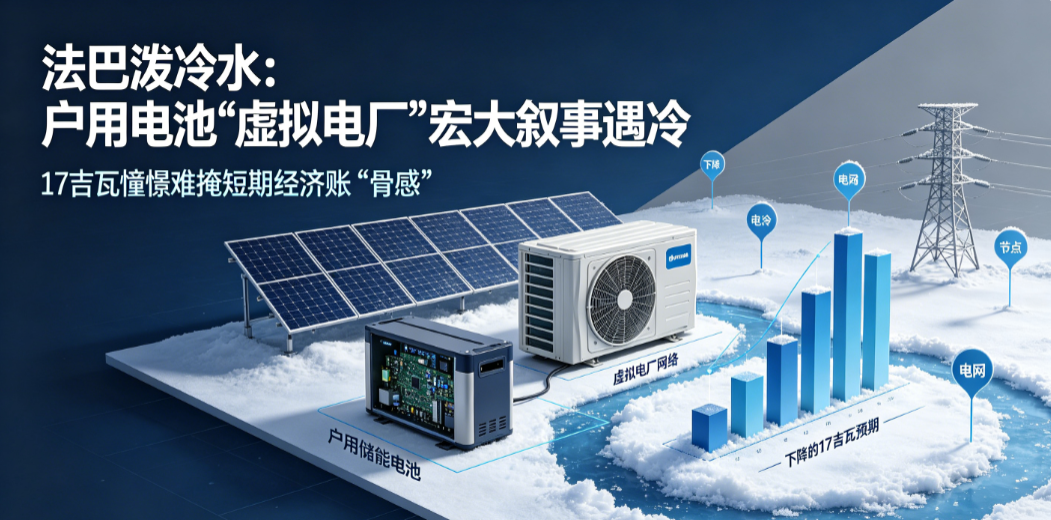
Clean Energy and the Hidden Truth: Opportunity and Risk Analysis of Virtual Power Plants
Introduction
In an era when the expansion of AI data centers and electrification is driving a sharp rise in electricity demand, the idea of integrating millions of home batteries into virtual power plants has become a global investor hotspot, especially as the U.S. grid comes under severe strain. However, BNP Paribas analysts have warned investors to remain cautious and not get carried away by the excitement. This article takes a deep dive into the opportunities and challenges of this business model and uncovers the hidden facts behind the eye-catching numbers.
A New Business Model, or Just an Illusion?
Recently, Sunrun (RUN.US), Tesla (TSLA.US), and energy services company Renew announced an ambitious plan to pool as much as 17 GW of battery and air-conditioning system capacity to support grid balancing. That figure is equivalent to the electricity needs of millions of households, sending Sunrun shares up more than 20% in a single day. Investors broadly believe clean energy companies can create new revenue streams by providing grid services and powering AI data centers.
But the key question is: how viable is this business model? Can clean energy companies transform from traditional power producers into grid stability service providers, while also earning income from selling solar systems and storage equipment, and from leasing excess generation capacity back to utilities and grid operators? It may look like a two-way revenue stream, but the real economics may not be as attractive as the market expects.
Capacity Scale Problem: Is 17 GW Just Wishful Thinking?
BNP Paribas analyst Musa Sutton pointed out that the mentioned 17 GW figure is far above the actual installed U.S. home battery base. The report estimates total nationwide home battery capacity at only about 6.7 GW, with most of it concentrated in California.
In addition, surplus capacity from California's grid may be hard to move to other regions, especially the Mid-Atlantic and other areas where data-center growth is fastest. That is a geographical barrier that is hard to overcome.
Given geographic constraints, existing contract obligations, and battery supply from competitors, the initial assessment suggests that near-term capacity available for new grid-support projects may be only a fraction of the announced figure. Even in the best case, if 2 GW of battery capacity were brought into regional power markets, estimated annual revenue would be only about US$90 million, and that revenue would still need to be shared with end users and technology partners.
Sutton admits there is indeed an opportunity, but before all details are finalized, the market may already have overvalued it.
AI Data Centers: Choosing to Build Their Own Backup Power
The report also focuses on PJM, a regional grid operator covering the U.S. Mid-Atlantic and parts of the Midwest. PJM is exploring how to connect large new users such as AI data centers to an already overburdened grid.
Under the revised proposal, whether and how large users should be required to cut power use during shortages will be decided by individual states rather than centrally by PJM. For data-center developers, this change actually adds more uncertainty.
BNP Paribas's assessment shows that most new data centers will continue to build their own large backup power systems, such as natural-gas generators or dedicated on-site independent power sources, to keep operations running when the grid is constrained. PJM's recent emergency rules allow large facilities to switch to backup generators when the grid is under peak stress, further underscoring the importance of power self-sufficiency.
Solar Project Growth: Monthly Fluctuations Don't Change the Overall Trend
Meanwhile, U.S. solar projects continue to grow. Government data for May showed that utility-scale solar projects under construction rose to 161 GW, up slightly from April. Although some projects were canceled or completed, the total still grew during the quarter.
BNP Paribas said new U.S. solar installations in 2026 could exceed 40 GW, while the construction pipeline suggests 2027 installations could reach 58 GW, above the bank's earlier forecast of 50 GW. The drop in May installations from the previous month is just normal seasonal volatility, not a sign of weak demand.
Conclusion: Short-Term Hype and Long-Term Potential
The clean energy industry is benefiting from two powerful trends: rapidly rising electricity demand and growing grid stress. The market has high expectations for home batteries, solar systems, and virtual power plants as key grid components.
BNP Paribas agrees with this long-term direction, but believes investors today must clearly separate long-term potential from near-term realizable value, especially when it comes to the broad narrative around dispatchable battery capacity. Investors should remain cautious before making decisions and carefully assess commercial viability.
The transition to clean energy is a path full of

ข้อควรระวังด้านลิขสิทธิ์: บทความนี้เป็นข้อมูลต้นฉบับของ ThaiDivi กรุณาติดต่อเราสำหรับการขออนุญาตเผยแพร่ซ้ำ




