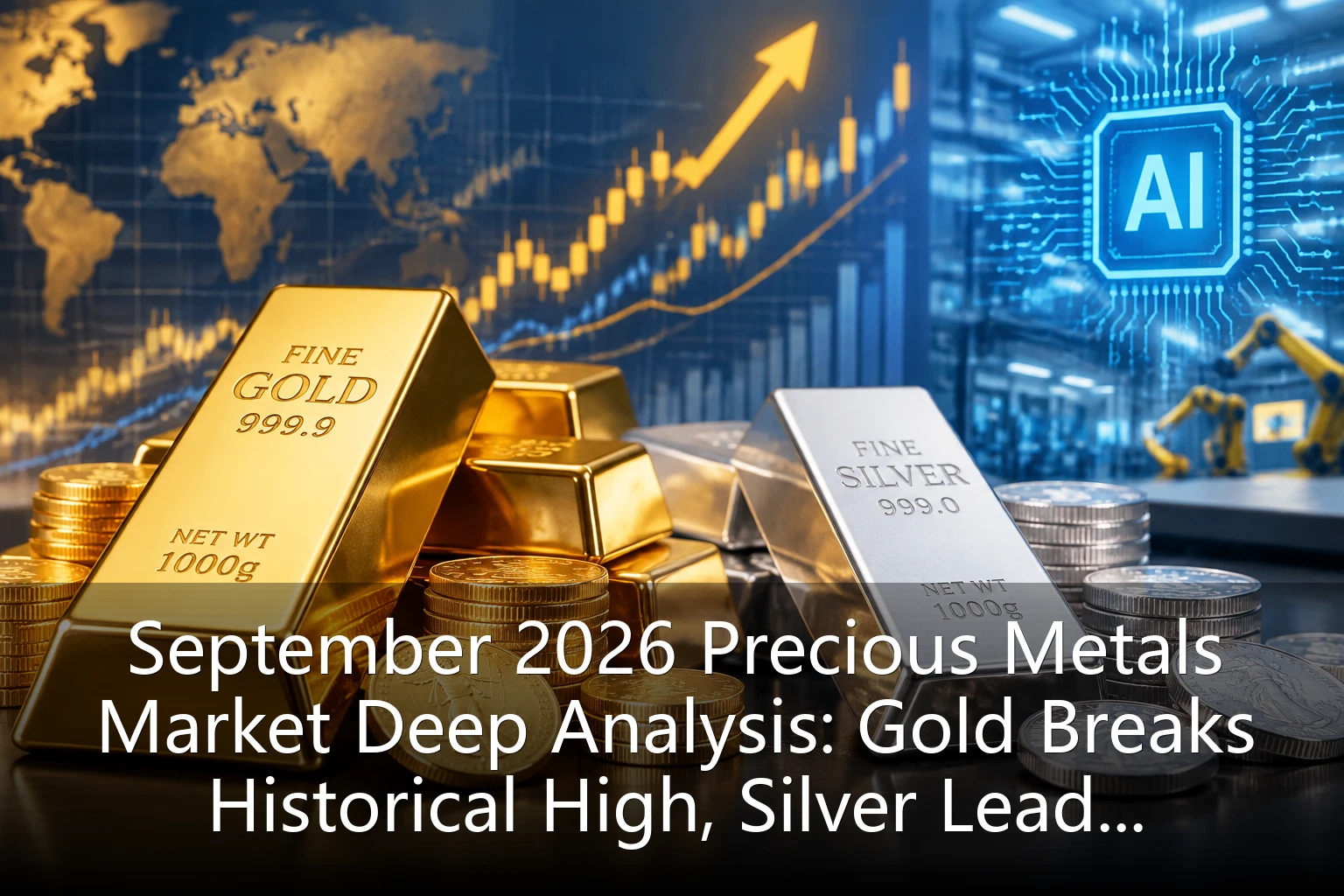
September 2026 Precious Metals Market Deep Analysis: Gold Breaks Historical High, Silver Leads Recovery Driven by AI Demand
In September 2026, the global precious metals market reached a historic moment as gold prices broke through the $2600 mark, setting a new historical high. Meanwhile, silver prices also surged significantly due to the explosion of artificial intelligence (AI) industrial demand, becoming a standout star in the recent precious metals market. Fluctuations in the Thai Baht exchange rate have intensified gold price volatility in Thailand, bringing both opportunities and challenges to local investors. This article will provide an in-depth analysis of current precious metals market dynamics, exploring how multiple factors are driving precious metal prices to new highs, and how investors can capitalize on this precious metals bull market.
Gold Prices Break $2600, Setting New Historical High
In September 2026, international gold prices continued to climb, successfully breaking through the key psychological barrier of $2600/ounce, setting a new historical high. This breakthrough marks the entry of the gold market into a new bull cycle, also reflecting increasing concerns among global investors about economic uncertainty. Analysts point out that the rise in gold prices is mainly driven by multiple factors, including continuous gold purchases by global central banks, rising geopolitical risks, and weak economic data from major economies.
The latest report from the World Gold Council shows that global central bank gold purchases reached record levels in the first half of 2026, with emerging market central banks continuing to be net buyers of gold, while some developed economy central banks have also begun to increase their gold reserves again. This trend not only adds demand support to the gold market but also strengthens gold's position as a safe-haven asset.
In terms of geopolitics, escalating tensions in the Middle East and the ongoing Russia-Ukraine conflict have prompted investors to seek safe-haven assets, with gold being the preferred choice. Meanwhile, weak US economic data, with July non-farm employment data below expectations and the ISM manufacturing PMI returning to expansion but with weak growth, have all strengthened market expectations for Federal Reserve interest rate cuts, further supporting gold prices.
Silver Prices Surge Sharply Due to Explosion of AI Industrial Demand
Compared to gold, the silver market performed more impressively in September 2026. With the rapid development and widespread application of artificial intelligence technology, the demand for silver in electronic components, cooling systems, and data center construction has increased significantly, pushing silver prices up by more than 9% in a single week, reaching a high in nearly five years.
Analysts point out that the explosive growth of AI technology has had a significant impact on silver demand. On one hand, AI chips and servers require large amounts of silver as conductive materials; on the other hand, the high power density of AI data centers brings cooling challenges, and silver's high thermal conductivity makes it an ideal cooling material. This explosive growth in industrial demand is changing the supply and demand dynamics of the silver market.
In addition, as a precious metal, silver also has safe-haven attributes. Against the backdrop of increasing global economic uncertainty, silver benefits from both industrial demand growth and attracts some safe-haven capital inflows, creating a dual positive effect. The gold-silver ratio has rapidly narrowed from above 80 at the beginning of the year to around 72, indicating that silver's performance relative to gold is stronger, and the market expects silver to enter a recovery cycle.
Thai Baht Exchange Rate Fluctuations Intensify Gold Price Volatility in Thailand
In the Thai market, fluctuations in the Thai Baht exchange rate have had a significant impact on domestic gold prices. In September 2026, the Thai Baht against the US dollar hit a one-year low, with a depreciation of more than 5%. This exchange rate movement directly led to a significant increase in gold prices quoted in Thai Baht, with domestic gold prices in Thailand reaching a new high for the year.
Thai gold market data shows that due to the depreciation of the Thai Baht, gold prices quoted in Thai Baht have increased by about 15% since the beginning of the year, while international gold prices quoted in US dollars increased by about 10% over the same period. This difference has created a unique trend in the Thai gold market, also providing arbitrage opportunities for local investors.
Notably, the depreciation of the Thai Baht has also intensified domestic inflationary pressures, further enhancing gold's attractiveness as a value-preserving asset. Many Thai investors view gold as an effective tool against inflation and exchange rate fluctuations, which has increased demand for physical gold in the country, especially gold jewelry and investment gold bars.
ETF Holdings Increase Significantly, Capital Accelerates Inflow into Precious Metals Market
In September 2026, global precious metals ETF (Exchange Traded Fund) holdings increased significantly, showing that investors are accelerating the allocation of precious metal assets. Data shows that gold ETFs have seen net inflows for five consecutive weeks, while silver ETF holdings surged by 567 tons in a single day, setting a record for the largest single-day increase.
The increase in ETF holdings reflects enhanced confidence from institutional investors in the precious metals market. On one hand, ETFs provide investors with convenient channels for precious metal investment; on the other hand, the increase in ETF holdings has further driven up precious metal prices, creating a positive cycle.
Analysts point out that the continuous inflow of ETF capital indicates that the fundamentals of the precious metals market are improving, and investors' recognition of the long-term allocation value of precious metals is increasing. Especially against the backdrop of slowing global economic growth and rising inflationary pressures, the value of precious metals as traditional safe-haven assets and inflation-hedging tools has once again been recognized by the market.
Investment Strategy Recommendations: Seizing Precious Metals Bull Market Opportunities
In the face of the strong performance of the current precious metals market, how should investors seize the opportunities of this bull market? Here are several key investment strategy recommendations:
- Diversified Allocation: Including gold and silver in investment portfolios can diversify risks and improve overall returns. Gold, as a traditional safe-haven asset, can provide protection during market turmoil; while silver has both industrial and precious metal attributes, offering greater elasticity in economic growth and technological development.
- Regular Fixed Investment: For ordinary investors, investing in precious metals through regular fixed amounts can reduce timing risks and smooth cost fluctuations. Especially when precious metal prices fluctuate significantly, regular fixed investment can help investors accumulate more positions at relatively low levels.
- Focus on ETF Products: For investors who do not want to hold physical precious metals directly, precious metal ETFs are an ideal choice. ETF products provide convenient trading channels and have good liquidity, suitable for short-term and medium-term investment.
- Combine Technical Analysis: When investing in precious metals, technical analysis can be combined to pay attention to key support and resistance levels, as well as changes in technical indicators, helping to judge market trends and formulate buying and selling strategies.
- Focus on Macroeconomic Data: Precious metal prices are closely related to macroeconomic data. Investors should closely monitor US non-farm employment data, CPI inflation data, Federal Reserve policy statements, etc., as changes in this data may have a significant impact on precious metal prices.
Risk Warnings and Outlook
Despite the strong performance of the current precious metals market, investors should also pay attention to potential risks. First, the trend of the US dollar is an important factor affecting precious metal prices. If the US dollar strengthens significantly, it may suppress precious metal prices. Second, the strength and speed of global economic recovery will also affect the performance of the precious metals market. If economic recovery is strong, it may reduce market demand for safe-haven assets. In addition, changes in geopolitical risks, adjustments in central bank monetary policy, and other factors may also have a significant impact on the precious metals market.
Looking ahead, analysts generally believe that the precious metals market still has good investment value. Against the backdrop of increasing global economic uncertainty and rising inflationary pressures, the value of gold as a traditional safe-haven asset and inflation-hedging tool will become more prominent. Meanwhile, silver benefits from the rapid development of emerging technologies such as AI, and industrial demand is expected to continue growing, potentially entering a super recovery cycle.
For Thai investors, fluctuations in the Thai Baht exchange rate have brought additional uncertainty to domestic gold prices, but have also created unique investment opportunities. Investors should closely follow the trend of the Thai Baht exchange rate and reasonably allocate gold assets quoted in Thai Baht to achieve the goal of asset preservation and appreciation.
In summary, the precious metals market in September 2026 shows a strong momentum of gold reaching new highs and silver recovering. Multiple factors are jointly driving the rise of precious metal prices. While seizing the opportunities of this bull market, investors should also pay attention to related risks and adopt reasonable investment strategies to achieve long-term stable investment returns.

ข้อควรระวังด้านลิขสิทธิ์: บทความนี้เป็นข้อมูลต้นฉบับของ ThaiDivi กรุณาติดต่อเราสำหรับการขออนุญาตเผยแพร่ซ้ำ