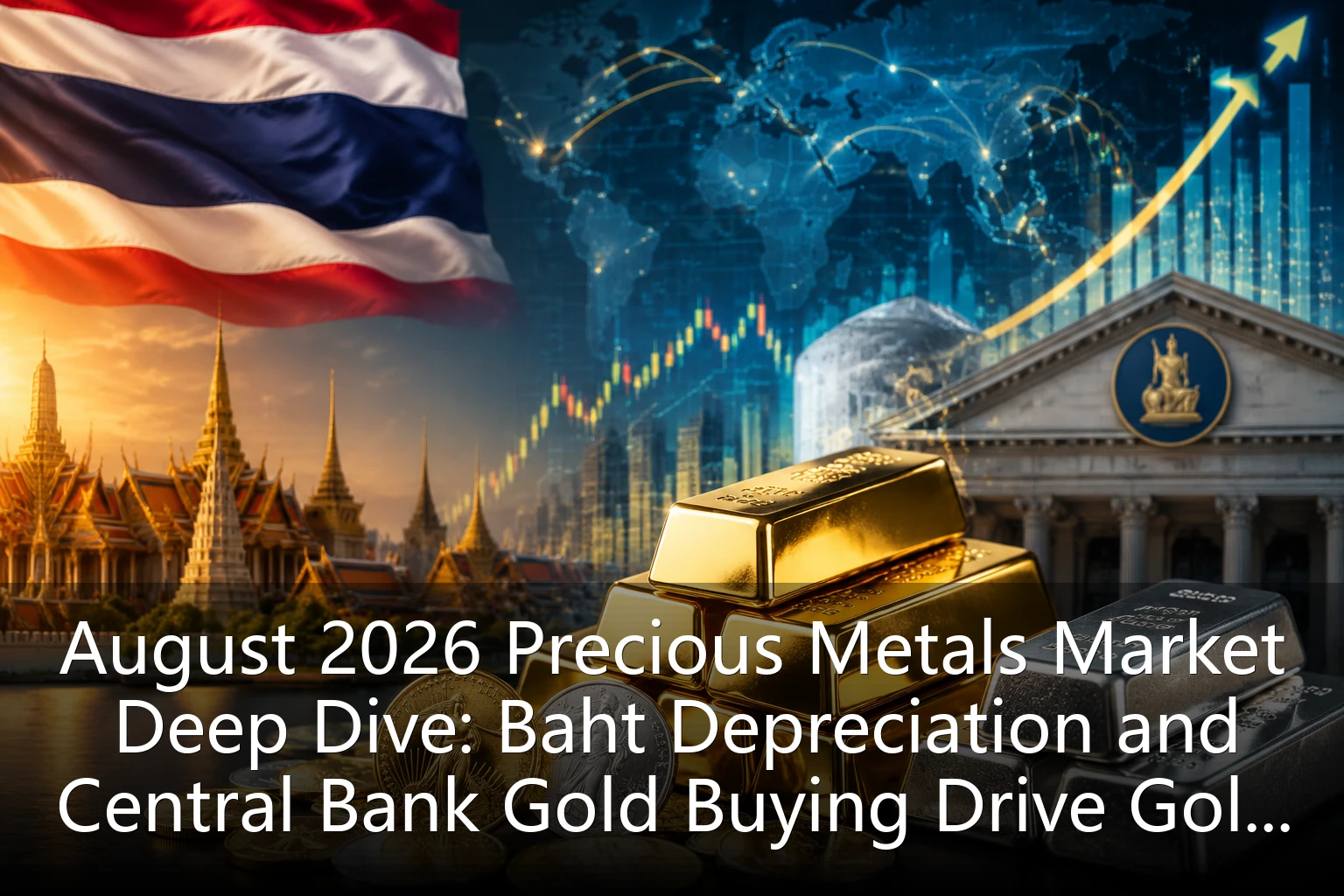
In August 2026, the global precious metals market surged again, with gold prices continuing to hit new highs, while silver, supported by strong AI industrial demand, moved independently. As an important precious metals consumer market in Asia, Thailand's baht exchange rate fluctuations significantly impact domestic gold prices, while central bank gold buying and hedging capital inflows provide a solid foundation for the bull market. This article will deeply analyze the current dynamics and future trends of the precious metals market from both international and domestic perspectives.
1. Gold Market: Hedging Demand and Central Bank Gold Buying Drive Prices to New Highs
As of August 23, 2026, London gold closed at $2,615 per ounce, up 3.2% from the same period last month, marking the third consecutive month of new highs. The core drivers of this rally come from two aspects: first, rising global geopolitical risks, with the ongoing tension in the Middle East triggering market hedging sentiment; second, the central bank gold buying boom continues, according to the latest data from the World Gold Council (WGC), global central bank gold purchases reached 456 tons in the first half of 2026, a 12% increase from the same period in 2025, with Asian central banks accounting for over 60%.
For Thai investors, baht depreciation is a key factor affecting domestic gold prices. Recently, the Bank of Thailand is expected to further cut interest rates to stimulate the economy, leading to the baht's exchange rate against the US dollar falling to 36.5 baht per dollar, a new low in a year. Domestic gold jewelry prices in Thailand have subsequently risen, with Bangkok gold shops quoting 18,500 baht per baht of gold jewelry, up 2.8% from last month. Analysts point out that baht depreciation increases the cost of imported gold, while also enhancing the investment appeal of domestic gold, as gold, as a hard currency, can hedge exchange rate risks.
1.1 Hedging Demand: Geopolitical Risks and Macroeconomic Uncertainty Boost Buying
In August 2026, the escalation of Middle East geopolitical conflicts became the main catalyst for gold hedging demand. The military standoff between Israel and Iran intensified, with the market worrying about energy supply disruptions, leading to rising oil prices and thus pushing up inflation expectations. At the same time, the US July non-farm payrolls data showed slowing job growth, raising expectations for Federal Reserve rate cuts, the dollar index weakened, further supporting gold prices. Hedge funds and institutional investors have been increasing gold ETF holdings, with global gold ETF holdings reaching 3,200 tons by mid-August, a 15% increase from the beginning of the year.
1.2 Central Bank Gold Buying: Asian Central Banks as the Main Force, Long-term Support for Gold Prices
Central bank gold buying is a long-term support for the gold market. WGC reports show that in the first half of 2026, Asian central banks such as China, India, and Thailand actively increased gold holdings, with the Bank of Thailand's gold purchases reaching 15 tons, the highest in nearly five years. Analysts believe that the motivation for Asian central banks to buy gold lies in diversifying foreign exchange reserves, reducing dependence on the US dollar, and at the same time coping with domestic inflation pressure. This trend is expected to continue, as most central banks still regard gold as a core component of stable assets.
2. Silver Market: AI Industrial Demand Triggers a Rally, ETF Holdings Surge
In line with gold, silver prices also showed strong performance in August, with London silver closing at $45.8 per ounce, up 9.5% from the same period last month, the highest since 2023. The main drivers of this rally come from the explosion of AI industrial demand and the rapid growth of ETF holdings.
2.1 AI Industrial Demand: Expanding Applications of Silver in Semiconductors and Heat Dissipation
The rapid development of AI technology has driven the growth in silver demand. Silver has excellent conductivity and heat dissipation properties, widely used in the manufacturing and heat dissipation systems of AI chips. According to data from the International Silver Association (ISDA), global AI industry demand for silver will reach 120 tons in 2026, a 30% increase from 2025. Among them, silver consumption in the semiconductor manufacturing industry accounts for over 40%, becoming the core area of silver demand. As a leading electronic manufacturing center in Southeast Asia, Thailand's silver industrial demand has also grown, with Bangkok silver futures prices rising to 46.5 baht per ounce, up 8.2% from last month.
2.2 ETF Holdings: Silver ETFs Surge by 567 Tons in a Single Day, Market Confidence Restored
Changes in silver ETF holdings reflect market confidence in silver. On August 15, the world's largest silver ETF (iShares Silver Trust) saw a net inflow of 567 tons in a single day, the largest single-day inflow since 2022. Analysts point out that this phenomenon indicates that institutional investors remain optimistic about the long-term price trend of silver, as the growth of AI industrial demand will ease silver supply tightness. In addition, silver investment demand has also increased with the rise in gold prices, as silver's price elasticity is higher, providing investors with greater profit potential.
3. Platinum Market: Hydrogen Economy and Supply Tightening Push Prices to Five-Year Highs
The platinum market also showed strong momentum in August, with London platinum closing at $1,150 per ounce, up 5.8% from the same period last month, the highest in five years. The main drivers of this rally come from the development of the hydrogen economy and supply tightening.
3.1 Hydrogen Economy: Platinum's Core Position in Fuel Cells
The development of the hydrogen economy has driven platinum demand. Platinum is a core material for fuel cell catalysts, used to convert hydrogen into electricity. According to data from the International Platinum Group Metals Association (IPA), global fuel cell industry demand for platinum will reach 80 tons in 2026, a 25% increase from 2025. As a pioneer in the hydrogen energy industry in Southeast Asia, Thailand's platinum demand has also grown, with Bangkok platinum jewelry prices rising to 12,000 baht per ounce, up 4.5% from last month.
3.2 Supply Tightening: South African Mine Accidents Lead to Production Decline
Supply tightening is another factor pushing up platinum prices. Recently, major platinum mines in South Africa experienced safety accidents, leading to a 15% drop in production, which in turn pushed up platinum prices. Analysts expect this supply tightening to continue until 2027, as the development cycle of new mines is long and cannot quickly make up for the production gap.
4. Investment Strategy Recommendations: How to Respond to Precious Metals Market Volatility
Facing the strong rally in the precious metals market, Thai investors need to formulate reasonable investment strategies to cope with exchange rate risks and market volatility.
- Gold Allocation: Diversify Risks, Hold Long-term: Gold, as a hedging asset, is suitable for long-term allocation. Thai investors can allocate through gold ETFs or gold jewelry, while paying attention to exchange rate risks, choosing hedging tools (such as forward foreign exchange) to reduce the impact of baht depreciation.
- Silver Investment: Focus on Industrial Demand, Short-term Trading: Silver's price elasticity is higher, suitable for short-term trading. Investors can focus on changes in AI industrial demand, choosing to buy at peak demand and sell when prices pull back. In addition, silver ETFs are convenient investment tools that can capture the rise in silver prices.
- Platinum Investment: Long-term Layout, Seize Hydrogen Economy Opportunities: Platinum is suitable for long-term investment, as the development of the hydrogen economy will bring sustained demand growth. Investors can consider platinum mining stocks or platinum ETFs to share the dividends of the hydrogen economy.
In summary, the strong rally in the precious metals market in August 2026 is the result of multiple factors, and investors need to pay attention to geopolitical, macroeconomic, and industrial demand changes, formulating investment strategies that match their own risk preferences.

ข้อควรระวังด้านลิขสิทธิ์: บทความนี้เป็นข้อมูลต้นฉบับของ ThaiDivi กรุณาติดต่อเราสำหรับการขออนุญาตเผยแพร่ซ้ำ