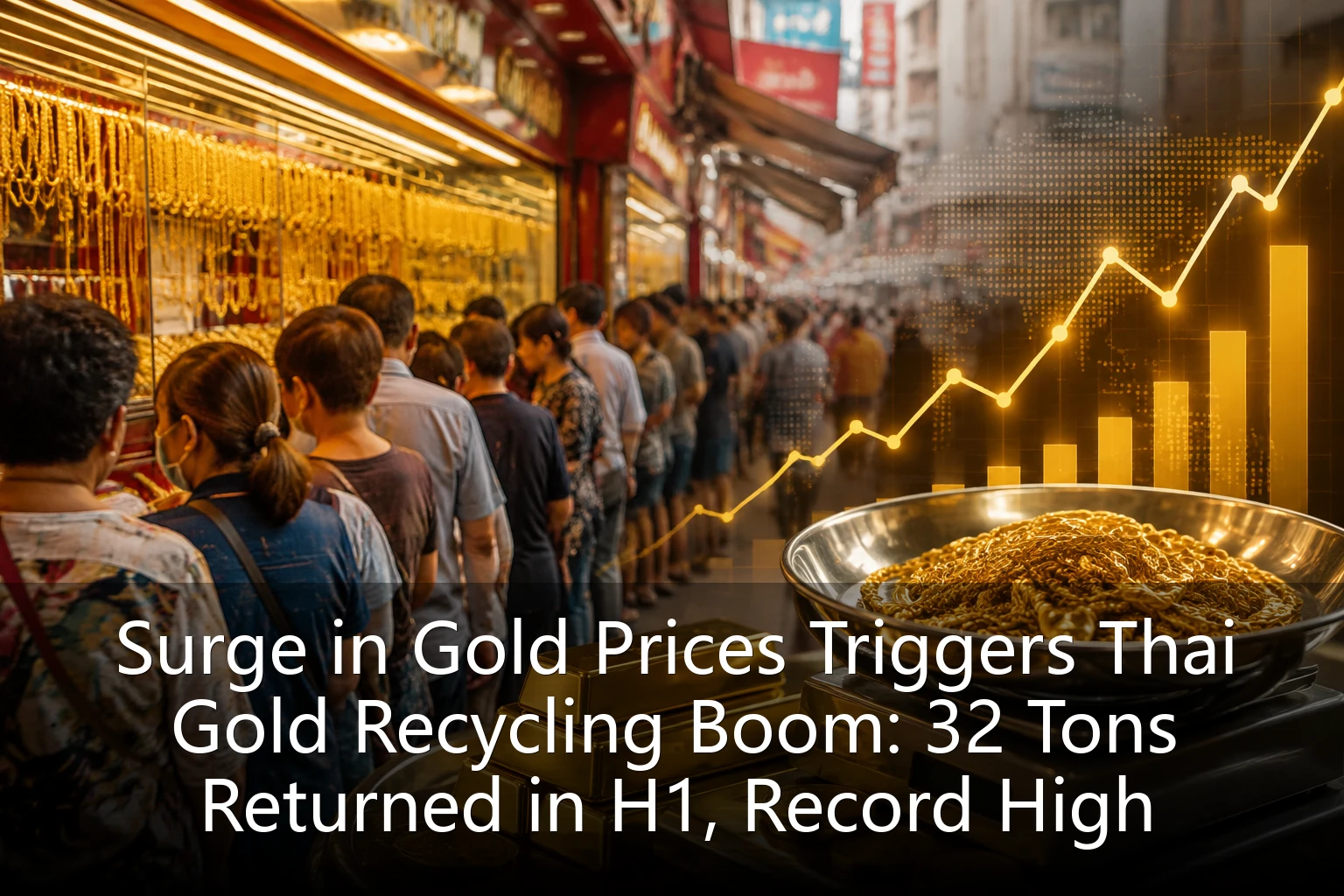
Global precious metals markets have been volatile in recent years, with gold prices repeatedly hitting new highs, affecting Thailand's domestic gold market. Today (the 1st), the Gold Traders Association of Thailand released the latest statistics showing that gold recycling volume in Thailand reached an astonishing 32 tons in the first half of 2026, up 45% year-on-year — a historic record. This highlights the sharp rise in demand among the public to "cash in" and "swap gold" amid high gold prices.
Soaring Gold Prices Boiling the Recycling Market
Yaowarat Road in Bangkok's Chinatown is Thailand's most important gold trading center. Recent days have seen long queues outside gold shops, but most people are not there to buy gold jewelry — they are holding old ornaments to sell for cash. According to the association's statistics, gold recycling volume in June alone rose 38% year-on-year, reflecting international gold prices breaking the all-time high of $2,800 per ounce, while baht-denominated gold prices surged as well, prompting holders to lock in profits.
Notably, this recycling wave is not limited to Bangkok. Major cities such as Chiang Mai, Phuket, and Nakhon Ratchasima are also seeing a "sell gold" frenzy. An association spokesperson said that over the past six months, recycling business at franchised gold shops nationwide has generally grown by 30% to 50%, with some popular shops even requiring numbered queue tickets.
Why Did Gold Recycling Volume Surge?
- Record highs trigger profit-taking: Baht-denominated gold prices climbed to 40,000 baht per baht-weight in July 2026, giving early investors substantial paper gains and prompting them to sell at highs to lock in returns.
- Baht depreciation accelerates value-preservation demand: Affected by Federal Reserve policy and emerging-market capital flows, the baht weakened to 38 per dollar at one point, making gold relatively more attractive. While people tended to shift cash into gold, high prices also led some to "sell first and wait."
- Jewelry trade-in craze: Gold jewelry retailers launched "old gold trade-in" promotions, attracting consumers to pay the price difference while gold prices are high, driving both recycling and sales upward.
- Healthy recycling profits: The spread between recycling and selling prices at gold shops narrowed to historic lows, meaning dealers were willing to pay higher acquisition prices, further boosting the public's willingness to sell.
Where Does Recycled Gold Go?
Most of this recycled gold does not stay in the country — it is sent to specialized refineries to be melted and recast into high-purity gold bars, with some supplied to local jewelry makers and the rest exported to international markets. As a key gold processing and trading hub in Southeast Asia, Thailand's re-treatment of recycled gold not only strengthens the local industrial chain but also provides additional physical supply to the global gold market.
Analysts note that the rise in public recycling helps ease supply-demand tension. Although central banks and institutional investors still have strong gold demand, recycled gold has become an important "marginal supply" at high price levels, which has a positive effect on market balance.
How Should Investors Respond?
Facing the heated gold market, investors should remain rational. First, gold recycling prices are usually lower than international spot prices and vary with purity and workmanship, so it is advisable to compare quotes. Second, for hedging through gold asset allocation, consider instruments such as Thai gold ETFs (ticker: GOLD) or futures, which offer better liquidity and no physical storage costs.
The association also reminds sellers to choose reputable gold shops and obtain clear transaction receipts to protect their rights.
Outlook
In the short term, gold price trends will remain driven by global monetary policy, geopolitical risks, and safe-haven sentiment. If prices stay high with volatility, the gold recycling boom is likely to continue. In the long run, the share of recycled gold in total supply is steadily rising, and its role in the precious metals market is becoming more important.
ThaiDiv Precious Metals will continue to keep you updated on the latest movements in gold, silver, platinum, and other precious metals markets, providing real-time quotes and in-depth analysis to help investors stay ahead.

ข้อควรระวังด้านลิขสิทธิ์: บทความนี้เป็นข้อมูลต้นฉบับของ ThaiDivi กรุณาติดต่อเราสำหรับการขออนุญาตเผยแพร่ซ้ำ