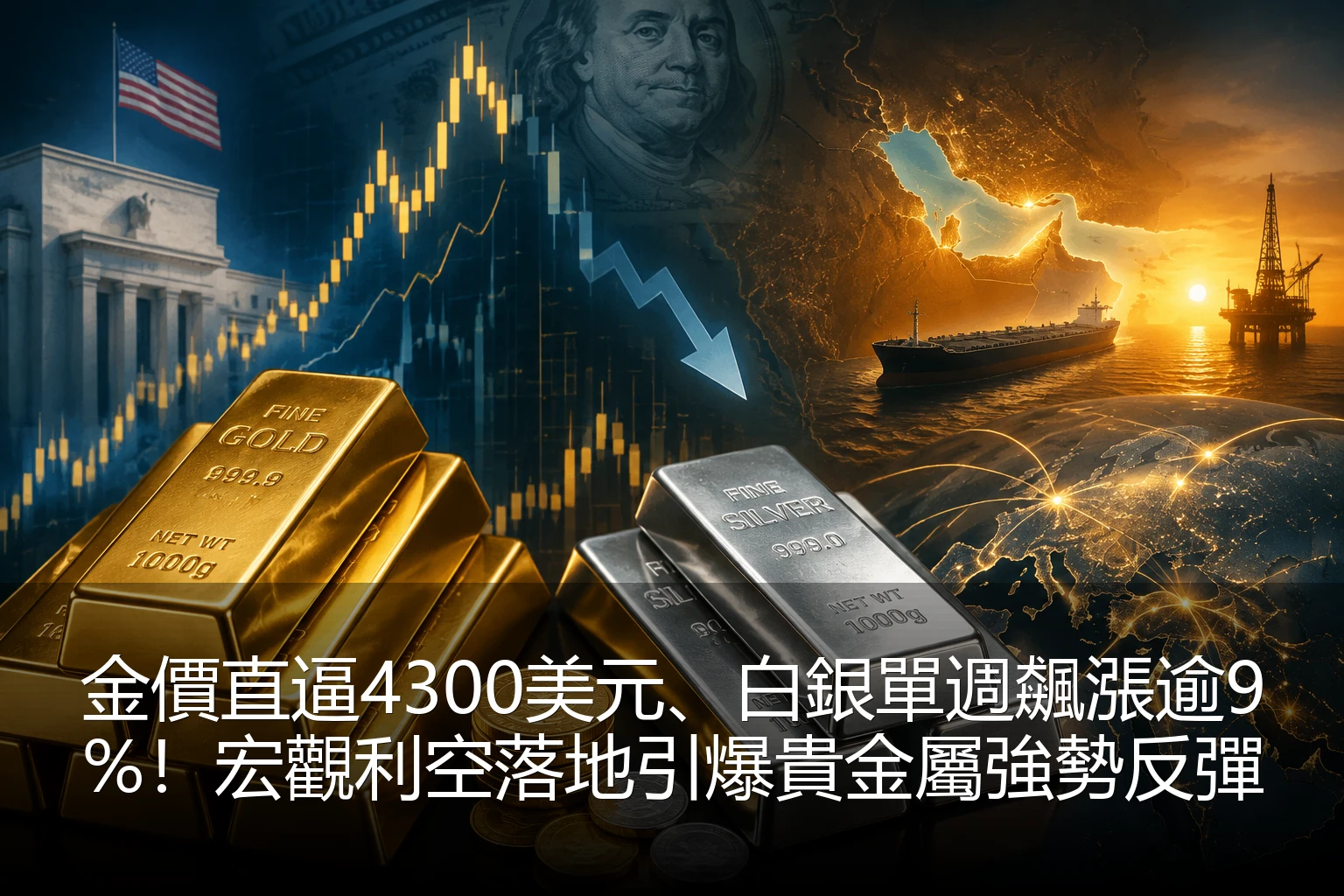
August 7, the precious metals market welcomed a long-awaited "double gold rally." Starting in Asian time, gold prices in London spot surged, reaching a high of $4291.46 per ounce, just one step away from the $4300 round number. The largest single-day gain reached 1.21%; COMEX gold futures also strengthened, peaking at $4343.3 per ounce. Even more impressive was silver—London spot silver briefly hit $63.654 per ounce, with a gain of 3.49%, setting a new high since June 23rd; COMEX silver's largest gain also reached 2.95%. As of Friday afternoon, spot silver maintained a gain of over 3%, trading near $63.35 per ounce, while spot gold rose about 1%, at $4286 per ounce.
Macro headwinds lead to a clear shift in sentiment. Looking back at this week's performance, the strength of precious metals can be seen as a typical manifestation of "profit-taking." Since the US Federal Reserve's FOMC meeting at the end of July announced a maintenance of interest rates, market expectations for a rate hike this year have continued to loosen. Subsequently, US July job numbers for new employment were significantly below expectations, and the ISM Services PMI also lagged market forecasts, with both employment and economic data cooling down, further reinforcing the expectation that the Federal Reserve may no longer tighten or might even pivot towards easing. Interest rate futures indicate that the market believes there is a 45% chance that the Fed will maintain rates in September, and a 55% chance of a cumulative 25 basis point hike. Meanwhile, US Treasury yields retreated from their highs, the dollar index weakened, and failed to break key resistance levels, lowering the cost of buying gold for holders of other currencies and easing the opportunity cost of holding non-yielding assets, providing strong valuation support for gold prices. Statistics show that international gold prices rose about 6% cumulatively this week, setting a multi-month high. Silver performed even better, with a weekly gain exceeding 9%, and platinum and rhodium prices also saw significant increases, resulting in a broad-based bullish pattern across precious metals.
Geopolitical situation reverses: "Pull back twice, push forward once" in risk aversion. Geopolitical factors are also a major driver of this rebound. Last weekend, President Trump announced that the US should suspend military strikes in response to an Iranian request, hinting at renewed negotiations. The possibility of passage through the Strait of Hormuz and nuclearization agreements briefly emerged, and oil prices significantly declined, leading to the first wave of gold price surge. However, near the weekend, Iran denied the optimistic statement by the US regarding the Strait being "to some extent open," geopolitical uncertainty increased, and safe-haven funds poured back into gold, supporting prices to continue their rally after stabilizing at a high level. Analysts point out that the "stop-start" game between the US and Iran is unlikely to end soon, and the dispute over the Strait of Hormuz is not fundamentally resolved. Geopolitical risk premiums will persist, serving as important support for gold prices below. If the situation deteriorates further, oil prices and safe-haven demand could surge simultaneously, giving precious metals a new round of upward momentum.
Silver's rally is stronger: supply and demand shortages and catch-up logic are emerging. In this market, silver's price elasticity is clearly superior to gold, with daily gains over 3% and weekly gains over 9% significantly outperforming gold. This is due to both the pull of safe-haven sentiment and the substantive support from industrial demand and supply/demand structure: Silver has experienced supply and demand shortages for several years, new industrial demands such as solar power, photovoltaics, and AI data center heat dissipation are continuously growing, while mining supply elasticity is limited and inventory is being depleted, meaning that silver often has greater upward room when macroeconomic sentiment turns warmer. From the gold silver ratio perspective, silver prices have lagged relatively, and valuations have room for recovery. Once macroeconomic pressure eases, funds will tend to flow into silver with greater elasticity, forming a "bounce" market. Traders should set the weekly London silver reference range for next week at $60 to $70 per ounce, and London gold at $4100 to $4500 per ounce, indicating that institutions maintain a bullish view for the overall market and recommend placing long positions on low volume, strictly controlling risk.
Thailand's gold price surged 1500 Thai Baht in one day, volatility is extreme. Rapid increases in international gold prices quickly transmit to the domestic Thai market. According to the Thailand Gold Association data, domestic gold prices in Thailand rose by approximately 1500 Thai Baht per baht weight on August 6th. The Association recorded 34 price increases in the market on that day, reflecting extremely volatile market fluctuations. Taking a gold bar of 96.5% purity, the purchase price was 66,550 Thai Baht per baht weight, and the selling price was 66,750 Thai Baht per baht weight; the selling price for gold bars reached 67,550 Thai Baht per baht weight, briefly touching a high of 68,100 Thai Baht after opening.
Hua Seng Heng, a well-known Thai gold dealer, analyzed that the weakness in the dollar combined with safe-haven buying is the main driver of gold price increases, but after a sharp daily rise, the risk of a short-term pullback increases. Investors should avoid chasing prices, wait for a pullback to place positions in batches, using $4,275 per ounce as the observation support for gold futures and $4,235 as a stop-loss reference. Furthermore, the Thai baht exchange rate is a key variable affecting domestic gold prices—on August 6th, the Thai baht fluctuated between 33.04 and 33.09 Baht per dollar. If the baht depreciates further, it will boost domestic gold prices; otherwise, it will offset the increase in international gold prices, and investors must monitor exchange rate risks simultaneously.
Technical analysis and non-farm data: rebound momentum and risk coexist. Technically, gold has reestablished itself above the 50-day moving average after several months of adjustment and has broken the previous resistance level from mid-June, triggering programmed trading short sales, which this resistance level is expected to become support. However, after a rapid price surge in the short term, momentum indicators are approaching overbought levels; without new capital replenishment, profit-taking may occur after the bullish sentiment is absorbed. Analysts remind that $4,270 to $4,275 per ounce is a key short-term observation range; holding above this level offers a chance to challenge the resistance, while failing to hold may lead to consolidation at higher levels.
Looking ahead, the release of US July non-farm employment data on Friday evening will be the decisive variable for short-term trends. The market currently expects job creation of about 80,000 people, with the unemployment rate remaining at 4.2%. If the data deviates significantly from expectations, gold and silver prices may experience dramatic fluctuations, and derivative trading risks are particularly high; investors should manage their positions and set stop-loss orders. Overall, against the backdrop of a weakening dollar, unresolved geopolitical risks, and strong investment demand in Asia (especially China), the medium-term bullish pattern for precious metals has not changed—the Chinese central bank has held gold reserves for 19 consecutive months, and gold bar and coin consumption in China reached 339,336 tons in the first half of the year, an increase of 28.42% year-on-year, and gold ETF holdings are climbing against the trend during the pullback, all providing a solid bottom support for gold prices. In terms of operation, short-term chasing should be cautious; placing positions in batches during a pullback and waiting for clear non-farm data is the relatively stable strategy for now.
Risk Warning: Escalation of the Middle East conflict could increase energy prices and inflation; persistent overheating in the US economy or a hawkish turn by the Federal Reserve could reverse this rebound trend.

ข้อควรระวังด้านลิขสิทธิ์: บทความนี้เป็นข้อมูลต้นฉบับของ ThaiDivi กรุณาติดต่อเราสำหรับการขออนุญาตเผยแพร่ซ้ำ