Precious Metals Sector Surges: Market Trends and Gold Allocation Value Analysis Ahead of the Fed Decision
Keywords: Gold, Precious Metals, Federal Reserve, Interest Rate Decision, Allocation Value, Gold ETF, Nonferrous Metals ETF, Inflation Risk
Introduction
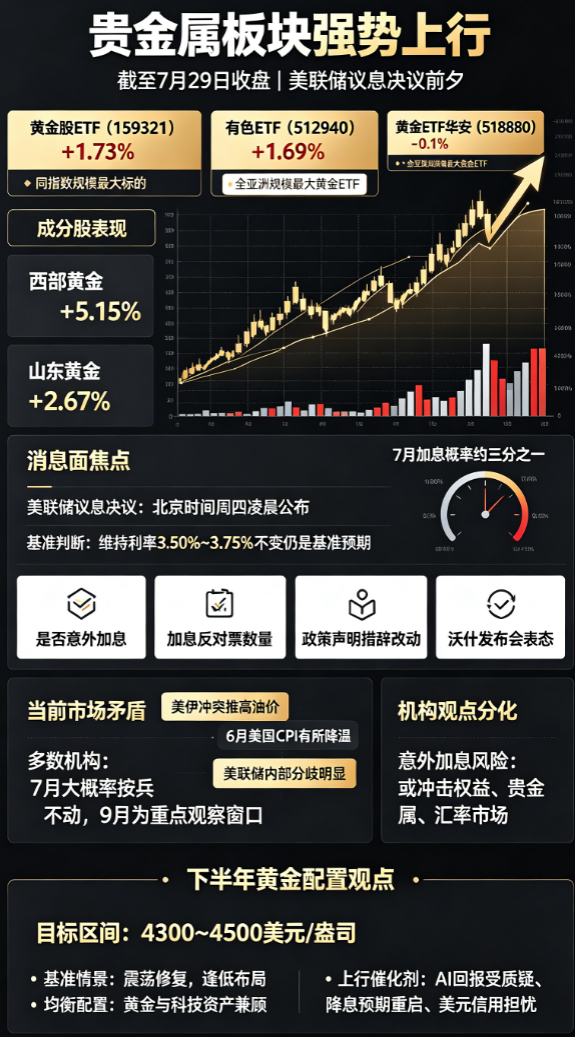
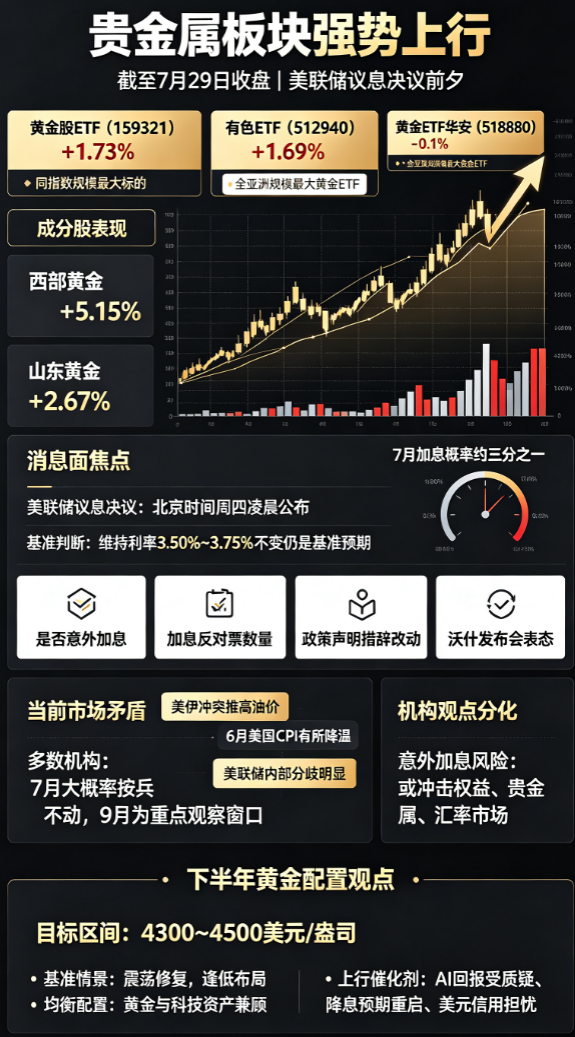
As of the close on July 29, 2026, global financial markets have once again focused on the precious metals sector. On that day, the Gold Stock ETF (159321) rose by 1.73%, the largest nonferrous metals ETF (512940) by index followed with a gain of 1.69%, while the largest gold ETF in Asia—Gold ETF Huaan (518880)—edged down 0.1%. Among component stocks, Western Gold led with a 5.15% gain, and Shandong Gold also rose 2.67%, indicating significantly heightened market attention on gold and related assets. However, behind this uptrend, the market is eagerly awaiting the Fed's interest rate decision due early Thursday Beijing time. The ambiguity of the rate path, combined with geopolitical risks, has increased short-term volatility in precious metals and set the stage for long-term allocation strategies.
1. Market Performance: Capital Inflows and Structural Divergence
Closing data on July 29 shows clear divergence among precious-metals-related ETFs. The Gold Stock ETF (159321) and the Nonferrous Metals ETF (512940) both rose, reflecting optimism about equity gold assets, while the slight decline of the physical gold ETF (518880) suggests that short-term safe-haven demand has not fully erupted. Component stock performance was more pronounced: Western Gold rose over 5%, and Shandong Gold strengthened in tandem, showing that leading companies benefit first from improving industry sentiment.
This trend reflects the market's expectation game regarding the Fed's policy stance. If interest rates remain unchanged in July, funding cost pressure will ease, benefiting profit recovery for gold mining companies. If there is an unexpected rate hike, it could suppress gold prices, but gold stocks might experience more volatile swings due to valuation elasticity. In terms of capital flows, recently heightened risk aversion coexists with a slight recovery in risk appetite, as investors attempt to rebalance positions before the Fed decision.
2. Four Key Points of the Fed Decision: Market Awaits "Shoe to Drop"
According to CME interest rate futures data, the probability of a rate hike in July is about one-third, with maintaining the rate at 3.50%–3.75% as the baseline expectation. However, the market's focus goes far beyond that. This FOMC meeting has four core points of interest:
- Unexpected Rate Hike? If the Fed goes against expectations and hikes, it would break the market's expectation of a "pause in the tightening cycle," impacting global equities, precious metals, and currency markets, with growth assets being particularly volatile.
- Number of Dissenting Votes: The degree of internal disagreement at the Fed will directly reflect uncertainty about the future policy path. An increase in dissenting votes would strengthen expectations that "the end of rate hikes is near."
- Changes in Policy Statement Wording: The statement's description of inflation, employment, and the economic outlook will be key clues for interpreting the subsequent pace of policy. For example, removing the phrase "further tightening" could be seen as a dovish signal.
- Powell's Press Conference Remarks: Every word from Fed Chair Powell at the press conference could trigger market volatility, especially comments on inflation stickiness, the labor market, and balance sheet reduction.
The multiple uncertainties make this decision an important window for observing a potential turning point for the market in the second half of the year. If the Fed stands pat, it will provide a temporary respite for gold. If there is an unexpected rate hike, it may trigger short-term panic selling, but safe-haven demand could then push gold prices higher again.
3. Divergent Institutional Views: September Window and Growth Asset Risk
At the institutional level, most analysts lean toward keeping rates unchanged in July, viewing September as a more important policy observation period. The logic is that the June U.S. CPI data showed marginal cooling, but core inflation remains sticky, so the Fed needs more time to verify whether the downward inflation trend is sustainable. Additionally, the Iran conflict continues to push up oil prices, further elevating inflation risks, forcing the Fed to balance "fighting inflation" against "preventing recession."
If an unexpected rate hike occurs, institutions predict that global equity markets will come under pressure in the short term, precious metals and currency markets will become more volatile, and growth assets—especially tech stocks and emerging markets—will see the most significant swings. This contrasts with the current high valuations driven by AI and other growth themes. If the Fed's tightening signal exceeds expectations, risk appetite could shrink rapidly, causing funds to flow from growth stocks to safe-haven assets like gold and U.S. Treasuries.
On the flip side, if the Fed maintains a dovish stance and September rate cut expectations heat up, gold could gain upward momentum driven by liquidity. Institutions generally believe that gold prices are currently in a range-bound recovery phase and need an event catalyst to break out of the current trading range.
4. Long-Term Gold Allocation Value: $4,300–$4,500 Range and Potential Catalysts
Relevant research institutions point out that gold has significant allocation value in the second half of the year, but a short-term breakout requires event-driven catalysts, with a target range of $4,300–$4,500 per ounce. In the baseline scenario, gold will follow a pattern of "oscillating recovery and buying on dips." Investors are advised to maintain a balanced allocation with tech assets to reduce volatility risk.
If the following three scenarios occur, gold could open up more upside:
- AI Investment Returns Questioned: Current enthusiasm for AI themes has boosted tech stock valuations. If AI applications disappoint in adoption or profitability, funds will flow back to real assets, benefiting gold.
- Rate Cut Expectations Rekindled: If U.S. economic data weakens and the Fed rekindles rate cut expectations, falling real interest rates would directly push gold prices higher.
- U.S. Fiscal Debt Issues Trigger Dollar Credit Concerns: In the long run, dollar credit is a key anchor for gold prices. If the U.S. government's fiscal deficit continues to deteriorate or debt ceiling negotiations stall, a shaken dollar credit would spur global central banks and investors to increase gold holdings.
Overall, gold combines safe-haven properties with inflation-hedging functions in the current macro environment. Short-term volatility provides suitable entry points for medium- to long-term allocation. Investors should closely monitor the Fed's policy path, geopolitical developments, and global liquidity changes to devise flexible asset allocation strategies.
Conclusion
The strong performance of the precious metals sector on July 29 reflects both the market's reaction to expectations of the Fed rate decision and the long-term allocation value of gold. In the short term, the Fed decision will dominate gold price fluctuations, but over the medium term, inflation, geopolitical, and fiscal risks will continue to support gold demand. Institutions generally recommend maintaining strategic focus on precious metals at current levels, buying on dips, and complementing with growth assets to navigate uncertain market conditions. With the September policy window approaching, the next breakout rally in the gold market is worth watching.

ข้อควรระวังด้านลิขสิทธิ์: บทความนี้เป็นข้อมูลต้นฉบับของ ThaiDivi กรุณาติดต่อเราสำหรับการขออนุญาตเผยแพร่ซ้ำ