Non-Ferrous Metals Profit Soars, Precious Metals Bottoming Signal Strengthens, AI and Tight Supply-Demand Boost Prices
Keywords: Non-ferrous Metals, Precious Metals, AI, Tight Supply-Demand Balance, Profit Growth, ETF
Introduction
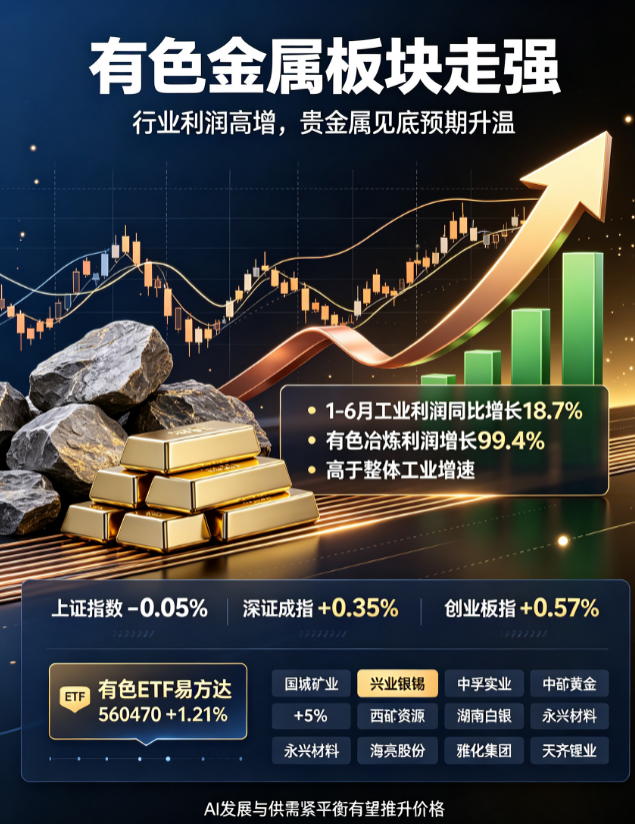
Since 2024, the global non-ferrous metals market has shown unprecedented activity. Against a backdrop of complex macro environments and frequent geopolitical risks, the non-ferrous metals industry stands out with its strong fundamentals, becoming a key focus in capital markets. According to the latest data from the National Bureau of Statistics, from January to June 2024, profits in non-ferrous metal smelting and rolling processing surged 99.4% year-on-year, significantly higher than the overall industrial profit growth of 18.7%. This data not only reflects the strong resilience of the industry's fundamentals but also signals the arrival of a new cyclical opportunity. At the same time, the precious metals market is also facing a major turning point, and the rapid development of AI technology has become a core driver for the release of demand for some minor metals. This article aims to deeply analyze the current landscape of the non-ferrous metals industry, explore the market outlook under multiple factors such as significant profit growth, increased probability of precious metals bottoming, AI development, and tight supply-demand balance, providing investors with a professional and comprehensive analysis perspective.
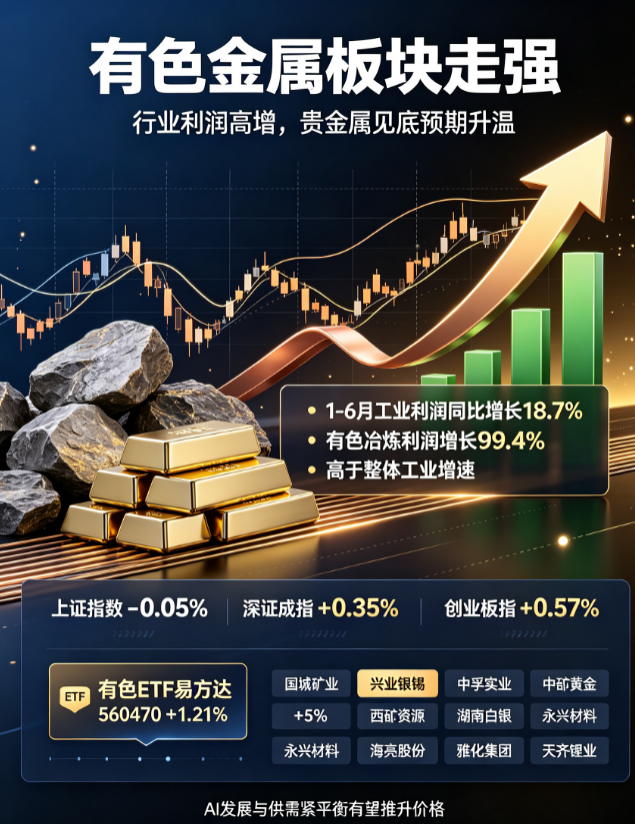
Note: The non-ferrous metals industry profit growth and related ETF performance show a positive linkage, reflecting the market's high recognition of the industry outlook.
I. Soaring Industry Profits: The Underlying Logic of Strong Fundamentals
In the first half of 2024, total profits of industrial enterprises above designated size grew 18.7% year-on-year, with the non-ferrous metal smelting and rolling processing industry leading major sectors with a 99.4% profit increase. This data is no accident but the result of combined effects of industry supply-demand dynamics, cost control capabilities, and policy environment.
1.1 Continuous Improvement in Supply-Demand Dynamics
On the supply side, capital expenditure growth in global non-ferrous metal mines has slowed in recent years, with some high-cost capacity gradually exiting the market. Coupled with stricter environmental policies and prolonged mining approval processes, the supply side shows obvious rigidity. For copper, ore grades continue to decline, new capacity delivery cycles extend, and supply elasticity weakens significantly. Meanwhile, demand remains robust, driven by rapid development in new energy, electric vehicles, photovoltaics, and energy storage, injecting strong momentum into non-ferrous metal consumption. The mismatch between supply and demand directly pushes up non-ferrous metal prices, driving substantial profit growth.
1.2 Cost Control and Technological Innovation
Non-ferrous metal enterprises have effectively controlled production costs through technological innovation and management optimization. Advanced smelting processes significantly improve metal recovery rates and reduce unit energy and material consumption. Additionally, leading companies actively build integrated industrial chains, extending upstream for resource control and downstream for high-value-added processing, greatly enhancing counter-cyclical resilience and profit stability. This positive feedback between cost and price further amplifies profit release space.
1.3 Catalytic Effect of Policy Environment
National attention to strategic mineral resources continues to rise. The implementation of the "Rare Earth Management Regulations" not only standardizes rare earth mining and smelting order but also guarantees the strategic value of rare earth resources at the institutional level. Meanwhile, driven by the "dual carbon" goals, the non-ferrous metals industry, as a crucial foundation of the new energy industrial chain, sees its strategic position further highlighted, attracting continuous allocation by social capital and professional institutions.
II. Precious Metals Market: Significantly Increased Probability of Bottoming
Amid the overall strength of non-ferrous metals, the precious metals market also faces a major turning point. The latest research by Guosheng Securities points out that precious metals ETFs have shown clear signs of position building, greatly increasing the probability of bottoming. This judgment is based on the following logic:
2.1 Significant Rebound in Gold and Silver Prices
Weekly data shows a notable rebound in gold and silver prices, with gold ETFs showing marginal inflows. Although market expectations for Fed rate hikes are rising, precious metal prices exhibit strength independent of interest rate expectations. This indicates that market capital rebalancing demand is becoming the dominant force driving the price rebound. According to CME FedWatch data, the probability of a July rate hike has risen significantly from 12.8% a week ago to 34.2%, but the strong performance of precious metals has not been suppressed, precisely reflecting capital recognition of precious metals' long-term allocation value.
2.2 Rising Geopolitical Risks
The renewed tension in the Middle East provides strong safe-haven support for precious metals. On July 24 local time, reports revealed that U.S. President Trump held a closed-door meeting with senior advisers to discuss military options against Iran, tightening U.S.-Iran relations. Crude oil prices surged and geopolitical uncertainty increased, directly driving a rise in market risk aversion. Gold, as a traditional safe-haven asset, saw significantly boosted demand. The market needs to closely monitor the Fed's interest rate decision on July 30 early morning, which will have an important impact on short-term precious metal trends.
2.3 Return of Capital Allocation Demand
From an institutional behavior perspective, the increase in precious metals ETF positions is not purely speculative but based on defensive allocation demand against global macro risks. Against the backdrop of persistent inflation pressure, slowing economic growth, and frequent geopolitical risks, precious metals' value preservation and hedging attributes are re-emphasized. This suggests that gold and silver may have completed a phased bottom and are entering the initial stage of a new upward cycle.
III. AI-Driven and Tight Supply-Demand: Strategic Value Reassessment of Minor Metals
The independent performance of the minor metals sector also deserves close attention. Datong Securities analysis indicates that the implementation of the "Rare Earth Management Regulations" combined with blocked Myanmar ore imports has intensified rare earth spot tightness, with strong overseas restocking demand directly pushing prices upward. Meanwhile, minor metals such as tungsten and antimony see supply contraction due to declining ore grades and environmental production limits, while downstream demand from photovoltaics and cutting tools remains resilient, exacerbating the supply-demand contradiction.
3.1 Rare Earths: Strategic Resource Value Highlighted
Rare earths are indispensable strategic resources for modern industry, widely used in permanent magnet materials, new energy vehicles, wind power generation, and military applications. The implementation of the "Rare Earth Management Regulations" marks a new stage of standardized, green, and high-value development for the rare earth industry. Myanmar, as an important rare earth import source for China, has seen import channels blocked recently, further tightening domestic supply. Strong overseas restocking demand and widening domestic-foreign price spreads open an upward price channel for rare earths.
3.2 Tungsten and Antimony: Supply Rigidity Drives Value Reassessment
Tungsten, known as the "industrial teeth," and antimony, called the "industrial monosodium glutamate," share distinct supply characteristics: declining ore grades, normalized environmental production limits, and slow new capacity release. On the demand side, high-end manufacturing sectors like photovoltaic tungsten wire and cemented carbide tools maintain resilient growth, with supply-demand contradictions steadily pushing up price centers. With further deepening of supply-side reforms, the main line of strategic resource value reassessment for tungsten and antimony will not change.
3.3 Gallium, Germanium, Indium Phosphide, Indium: AI Computing Power Demand Drives New Growth
The explosive development of artificial intelligence technology is creating huge demand for high-end semiconductor materials. Gallium, germanium, indium phosphide, and indium are key raw materials for manufacturing core components such as high-speed chips, optoelectronic devices, lasers, and sensors. The exponential growth of AI computing power directly drives demand for these rare metals. Implementation of export control policies prompts overseas customers to stockpile, further widening domestic-foreign price spreads. With clear supply rigidity, the strategic resource value reassessment continues, and related listed companies maintain close capital attention.
IV. Non-ferrous Metals ETF E Fund (560470.SH): Barometer of Non-ferrous Metals Boom in Capital Markets
As a tool product tracking the CSI Segmented Non-ferrous Metals Industry Theme Index, the Non-ferrous Metals ETF E Fund (560470.SH) has been regarded as an important window for observing investment heat in the non-ferrous metals sector since its listing. This index selects large-scale, liquid listed company securities from the segmented non-ferrous metals industry as samples, comprehensively reflecting the overall performance of the non-ferrous metals industry. The top five weight stocks include Zijin Mining, China Molybdenum Co., Northern Rare Earth, Aluminum Corporation of China, and Huayou Cobalt, basically covering leading domestic non-ferrous metals companies.
As of July 29, Non-ferrous Metals ETF E Fund (560470) rose 1.21%, with constituent stocks actively trading. Guocheng Mining rose over 5%, while Yili Resources, Western Gold, Zhongfu Industry, China Mineral Resources, Hunan Silver, Yongxing Special Materials, Hailiang Co., Yahua Group, Tianqi Lithium, and other stocks showed positive trends. This performance directly reflects the continued improvement of industry fundamentals and also embodies the market's optimistic expectations for the future prosperity of the non-ferrous metals sector.
V. Risk Warnings and Outlook
Although the non-ferrous metals industry is in an upward prosperity cycle, investors still need to pay attention to the following risk factors:
- Macro Policy Uncertainty: The Fed's rate hike path and potential shifts in major central banks' monetary policies may cause periodic shocks to commodity prices.
- Geopolitical Risks: External uncertainties such as the Middle East situation and U.S.-China trade friction may transmit to non-ferrous metals markets through supply chains and cost sides.
- Demand Growth Slowdown Risk: If global economic growth slows unexpectedly, demand for non-ferrous metals in new energy, infrastructure, and other areas may be lower than expected.
- Supply-side Unexpected Disruptions: Mine production interruptions, adjustments to environmental production limit policies, etc., may cause abnormal short-term price fluctuations.
Looking to the second half of the year, driven by multiple factors such as accelerated AI development, deepening tight supply-demand balance, and increased probability of precious metals bottoming, the non-ferrous metals industry is expected to continue profit high growth. The main line of strategic resource value reassessment will continue to attract capital attention, the precious metals allocation window is opening, and AI-related demand for minor metals will become a new growth pole. Investors should fully grasp structural opportunities in the industry while managing risks, seeking long-term value amid volatility.
Data sources: National Bureau of Statistics, Guosheng Securities, Datong Securities, CME FedWatch, related company announcements. Investment carries risks; enter the market with caution.

ข้อควรระวังด้านลิขสิทธิ์: บทความนี้เป็นข้อมูลต้นฉบับของ ThaiDivi กรุณาติดต่อเราสำหรับการขออนุญาตเผยแพร่ซ้ำ