2026 Precious Metals Market H2 Outlook: Volatility Recovery and Structural Divergence
Keywords: Precious Metals, Gold, Silver, Platinum Group Metals, Market Outlook
Introduction
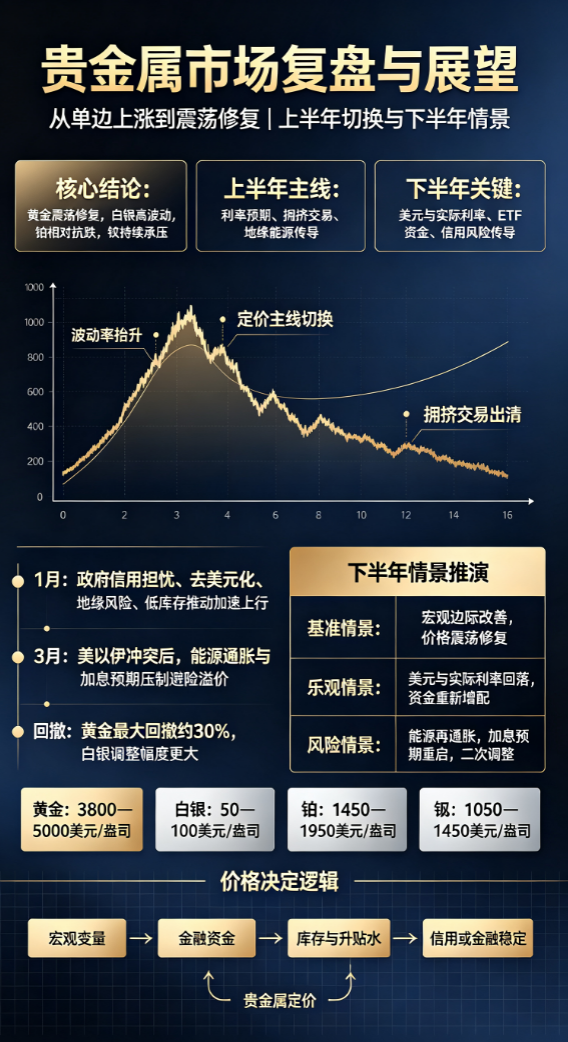
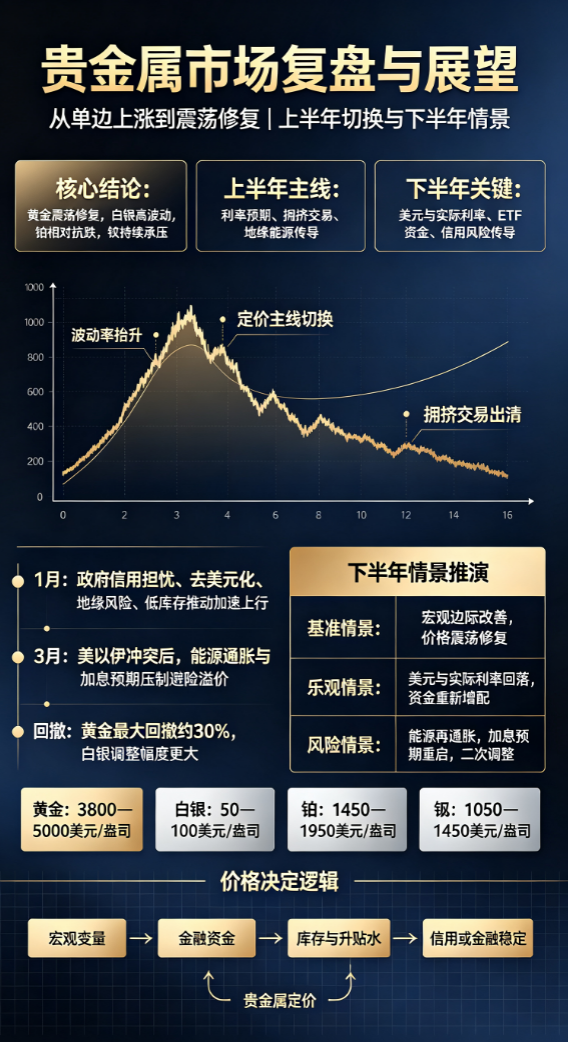
In H1 2026, the precious metals market underwent a sharp shift from one-sided rally to deep correction, with significantly elevated volatility becoming the core feature. The pricing focus shifted from long-term allocation logic to changes in interest rate expectations and crowded trade unwinding. The interplay of geopolitics, monetary policy, and macroeconomics profoundly affected price paths of various products. Looking to H2, the market environment is expected to shift from clearly pressured to marginally improved, but structural divergence will continue to intensify, and the performance differences between gold, silver, and platinum group metals will further widen.
H1 Review: Volatility Elevation and Crowded Trade Unwinding
In January of this year, factors such as sovereign credit concerns, de-dollarization trends, geopolitical risks, and low inventories jointly drove precious metal prices to accelerate upward. Gold briefly touched a historic high of 5,598 USD/oz, with silver posting even more significant gains. However, as crowded trades unwound, margins were raised, and monetary policy expectations turned hawkish, the market quickly reversed. After the US-Israel-Iran conflict erupted in March, geopolitical risks pushed inflation and rate hike expectations higher through energy prices. The US dollar and real yields on Treasuries rose in tandem, and gold's accumulated safe-haven premium was suppressed by opportunity cost, with a maximum drawdown of about 30%. Silver, affected by high leverage and its industrial nature, saw its adjustment range further expand.
H2 Macro Environment: From Pressure to Marginal Improvement
In H1, the core pricing logic combination was energy shock, high inflation, strong dollar, and high real yields, with AI capital expenditure reinforcing the relative advantage of the US economy. Currently, crude oil prices have clearly retreated, inflation expectations have cooled, and employment data has begun to weaken. The impact of tightening mainly remains at the level of policy expectations and asset prices; actual rate hikes and real credit contraction have not yet fully materialized.
If the US-Iran situation continues to ease, core and services inflation slow marginally, rate hike expectations may gradually be revised. The momentum for further rise in the dollar and real yields will weaken. However, the US economy and AI investment remain resilient, so the dollar and real yields are more likely to shift from a strengthening trend to high-level volatility. Liquidity conditions will see some pressure relief but it will be difficult to quickly return to an accommodative state.
Gold: Long-Term Logic and Short-Term Variables
The long-term allocation logic for gold remains intact. High global debt and deficits, combined with rising interest expenses, continue to erode the long-term real returns of sovereign credit assets. Geopolitical division, financial sanctions, and reserve diversification are constantly increasing gold's strategic allocation value. In Q1 of this year, global central banks made net gold purchases of approximately 244 tons. Demand for private gold bars and coins remained high, and long-term funds are still accumulating on price pullbacks.
However, central bank gold purchases primarily support the valuation center and cannot fully offset short-term price pressure from North American ETF redemptions, futures long liquidation, and weakening trend-following capital. The impact of geopolitical risks needs to be distinguished by transmission channels: if the shock mainly pushes up oil prices, inflation, and policy rates, gold prices may actually come under pressure; if the shock triggers credit spread widening, financial stability damage, or challenges to dollar creditworthiness, gold's safe-haven attributes may reassert dominance over prices.
For gold prices to shift from volatility recovery to a trend reversal, three conditions are needed: sustained North American ETF inflows, a trend decline in the dollar and real yields, and geopolitical shocks transmitting to credit or financial stability areas with risk consequences.
Silver: Supply-Demand Gap Narrows, Price Elasticity Depends on Financial Factors
The silver market remains in a supply deficit, but the gap continues to narrow. Global silver total supply is expected to decline 0.8% YoY in 2026, while total demand is forecast to fall 3.2%, narrowing the deficit from 2,344 tons in 2025 to 1,463 tons, about 4.2% of total demand. On the supply side, mine production is expected to grow 1.5%, and high silver prices are boosting recycling supply growth of 7%; the decline in total supply mainly stems from the normalization of supply after producer hedging operations.
Industrial silver demand is down 5.2%, with the decline highly concentrated in the photovoltaic sector. Due to lower cell production and reduced unit silver consumption, photovoltaic silver demand is expected to fall 24.4% YoY. Excluding photovoltaics, electrical and electronics, solder, and other industrial demand still grew 3.3%, with AI, data centers, and robotics related silver consumption as the main increments. High silver prices clearly squeezed jewelry and silverware consumption, but physical investment demand for bars and coins grew 18%, almost exactly offsetting the decline in traditional consumption.
Future silver price elasticity will depend more on ETF and physical investment inflows, deliverable inventories, lease rates, and regional premiums/discounts, while the annual deficit's explanatory power over prices has diminished.
Platinum Group Metals: Platinum Deficit and Palladium Surplus Pattern Continues
The price divergence between platinum and palladium will persist. In 2026, the platinum market will have a deficit of about 297,000 ounces, but the gap will narrow due to lower investment and jewelry demand combined with increased recycling supply. The palladium market is expected to see a surplus of about 214,000 ounces, with declining auto catalyst demand and weaker investment demand constituting medium-term downward pressure.
Comprehensive Outlook and Price Ranges
Overall, H2 is more likely to present a pattern of gold price volatility recovery, high silver price volatility, platinum relatively resilient, and palladium continuously under pressure. Under the base case scenario, the core trading range for COMEX gold is expected at 3,800 USD to 5,000 USD/oz, COMEX silver at 50 USD to 100 USD/oz, NYMEX platinum at 1,450 USD to 1,950 USD/oz, and NYMEX palladium at 1,050 USD to 1,450 USD/oz.
If the dollar and real yields see a trend decline and financial capital re-allocates, precious metal prices could still challenge previous highs. If energy prices rise again, reigniting inflation and rate hike risks, precious metal prices will still face pressure for a second adjustment.
Conclusion
In H2 2026, the precious metals market will seek direction amid macro marginal improvement and structural divergence. Gold's long-term allocation value is solid, but short-term needs a catalyst for financial capital return. Silver's supply-demand fundamentals are loosening, with price elasticity shifting to financial factors. Platinum group metals continue the pattern of platinum deficit and palladium surplus. Investors should closely monitor the dollar and real yield trends, geopolitical risk transmission paths, and ETF capital flows, flexibly responding to the intensified volatile market environment.

ข้อควรระวังด้านลิขสิทธิ์: บทความนี้เป็นข้อมูลต้นฉบับของ ThaiDivi กรุณาติดต่อเราสำหรับการขออนุญาตเผยแพร่ซ้ำ