Review of the Precious Metals Market in the First Half of 2026: Pricing Logic and Outlook Amid Pullbacks
In the first half of 2026, the international precious metals market experienced significant volatility and pullback. As of June 30th, the contract prices for gold as the main commodity fell by 26% compared to the year's high, while silver contract prices dropped nearly half. After the frenzy at the beginning of the year and subsequent panic, the market is gradually returning to a rational pricing trajectory. This article will deeply analyze the underlying logic of this market evolution from multiple dimensions, including macroeconomic conditions, geopolitics, and investor sentiment.
From a core price ratio perspective, the current gold-silver ratio is within the historical normal range, indicating that neither metal has experienced a clear mispricing. Silver's price volatility is significantly greater than that of gold due to its specific industrial characteristics, which explains its larger decline. Considering this, the following analysis will primarily anchor on gold.
Macroeconomics: Dollar Strength and Diverging Interest Rate Paths
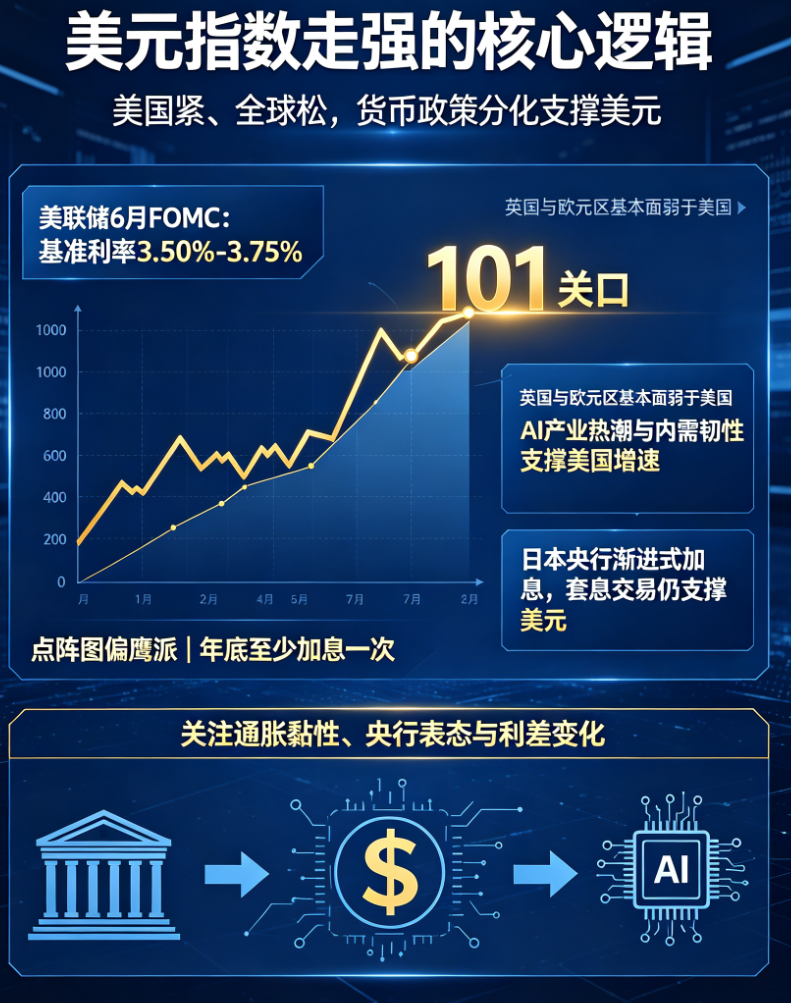
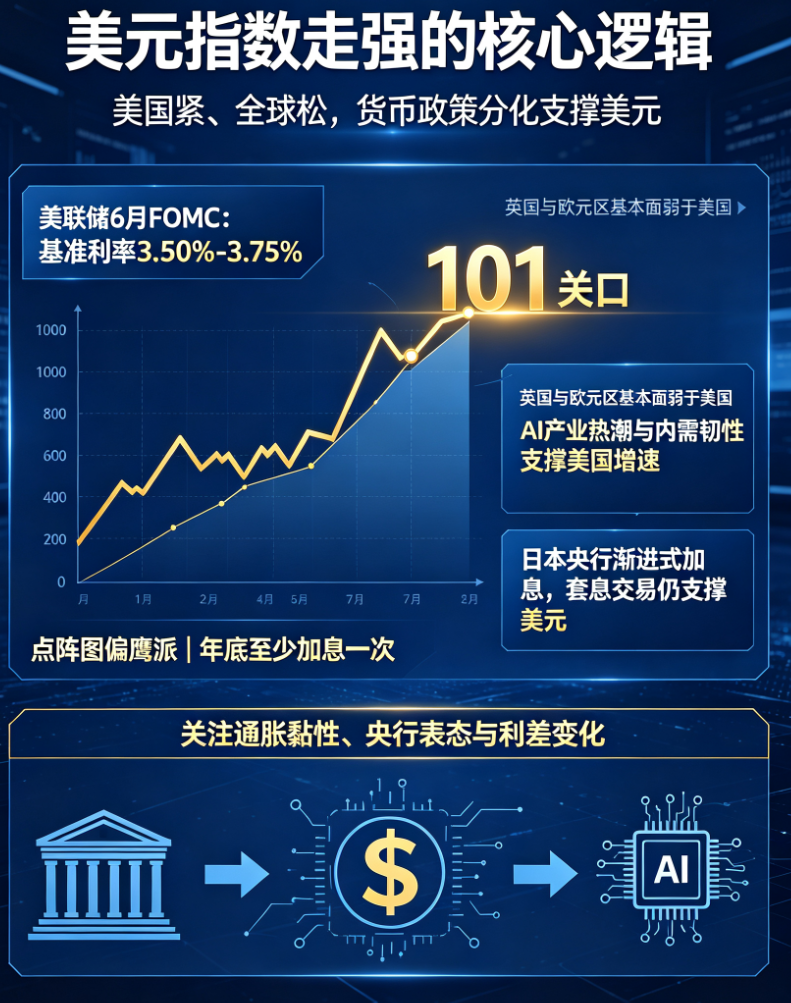
The divergence in central bank monetary policies, with the US tightening and the rest of the world easing, is the core driving force behind the recent strength of the dollar index. Although inflation levels in major global economies have cooled, they exhibit clear "inflation stickiness." Market expectations for rate hikes exist for the Federal Reserve of the US, the Bank of England, the Bank of Japan, and European central banks. Although the Federal Reserve's FOMC meeting in June kept the benchmark interest rate within the 3.50%-3.75% range, the dot chart leaned hawkish, with market expectations for at least one more rate hike by year-end, and the median Federal Funds Rate expected to rise.
The dollar index broke 101 within the past year, driven by several factors: the economic fundamentals in the UK and the Eurozone are clearly lagging behind the US, while they maintain relatively strong growth fueled by the AI industry boom and domestic demand. The gradual tightening by the Bank of Japan is insufficient to reverse the large interest arbitrage between the dollar and the yen.
Geopolitics: The Game Between Energy Crisis and Safe-Haven Assets
The impact of geopolitical risks on gold prices is not linear. The impact of the US-Venezuela incident and the US-Iran conflict in the first half of the year had distinctly different effects on gold prices, stemming from differences in market core pricing logic and price transmission paths.
From a pricing logic perspective, the market generally expected the Federal Reserve to begin a rate-cutting cycle, giving precious metals, especially gold, a higher allocation value. However, when the US-Iran conflict escalated at the end of February, inflation stickiness and the expectation of high interest rates became mainstream, and geopolitical conflicts suppressed gold prices from surging.
Observing the price transmission path, when events threatening global energy supply, such as the Strait of Hormuz, occur, a pattern of "oil prices rise, dollar strengthens" will emerge in the short term. Non-US economies with high dependence on oil imports will face the dual risks of inflationary pressure and supply chain disruptions. In exchange for dollar liquidity, central banks in some oil-importing emerging markets sell off gold in large quantities, causing gold prices to fall instead of rise. This is essentially a game between two classes of safe-haven assets.
Investor Sentiment: From Frenzied Buying to Panic Selling
Extreme fluctuations in market sentiment have a magnifying effect on overall market trends. In August 2025, central banks worldwide continued to stabilize gold buying, providing long-term emotional support for the market. Gold prices rose significantly in September, reaching the largest single-month gain since August 2011, a trend that continued until January 2026. The belief that "gold will only rise and never fall" was constantly reinforced, with the market's main tone being "gold price breaking through 6000 points." In March 2026, with the escalation of Middle East geopolitical conflicts, a noticeable change in market structure occurred. Emerging market countries with high dependence on oil imports reduced gold reserves as a supplement to dollar liquidity, while institutions that had previously overbought gold realized profits. Under the influence of multiple funding sources, gold experienced a significant pullback on March 23rd.Second Half Outlook: Range-bound Volatility and Structural Support
The release of data from the Fed's newly appointed Chair Kevin Walsh in June showed that new job creation in the US for that month was only 57,000, and historical data was significantly revised downward. Weakening employment data led the Federal Reserve's monetary policy decisions into a balancing act between growth and inflation, causing expectations for interest rate hikes to cool down, which pushes for a revaluation of major asset classes globally. Looking ahead to the second half, under current aggregate forecast conditions, precious metal prices may maintain a range-bound trend. However, if systemic risks increase, such as a further deterioration in the global economic situation, the outbreak of a new round of geopolitical conflicts, or a large influx of buying funds during low points, precious metal prices still have clear upward potential. Meanwhile, structural support from central bank buying demand and long-term investors may limit the space for significant declines in gold and silver prices. In a globally uncertain environment, gold and silver, which possess monetary properties, still retain the investment resilience of strategic assets.
ข้อควรระวังด้านลิขสิทธิ์: บทความนี้เป็นข้อมูลต้นฉบับของ ThaiDivi กรุณาติดต่อเราสำหรับการขออนุญาตเผยแพร่ซ้ำ