Precious Metals Market Deep Analysis: From Violent Fluctuations to DCA Wisdom
Introduction
Recently, precious metals prices have experienced unprecedented violent fluctuations, falling into a volatile tug-of-war pattern. Since March, COMEX gold prices have taken a roller-coaster ride, plummeting from a high of $5,000/oz. Particularly on March 18-19, two trading days saw a cumulative drop of over $400, breaking through multiple round numbers in succession, with a weekly decline of about 10.5%, the largest single-week drop in nearly 43 years since 1983. This phenomenon not only stunned market participants but also sparked deep reflection on the underlying logic of the precious metals market. This article will explore the causes of precious metals price volatility, investment logic, and wisdom to navigate cycles from multiple dimensions.
Phenomenon and Essence: Multiple Causes of Precious Metals Volatility
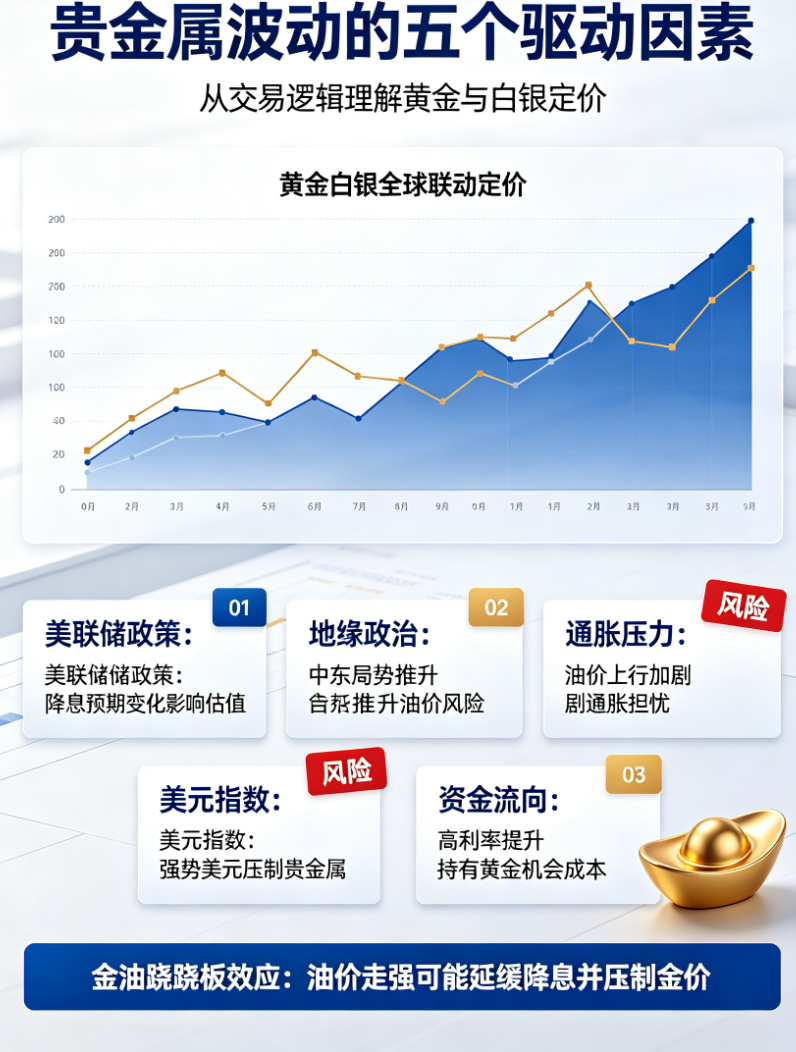
The violent fluctuations in the precious metals market are the result of the complexity of international financial markets and a confluence of multi-dimensional factors. From a real trading perspective, gold and silver adopt a global unified pricing mechanism, with prices highly linked to the international market. Their trends are affected by the interplay of factors such as Fed monetary policy expectations, global geopolitical situations, inflationary pressures in major economies, US Dollar Index fluctuations, and capital flows from large institutions. Particularly, the "gold-oil seesaw" effect – escalating geopolitical tensions in the Middle East drive up oil prices, intensifying inflation concerns and making the Fed more cautious on rate cuts, forming a cycle that suppresses gold prices. Moreover, since gold itself does not generate interest – unlike stocks, bonds, or deposits – when interest rates remain high, the opportunity cost of holding gold increases, potentially diverting funds from gold to equity or bond markets.
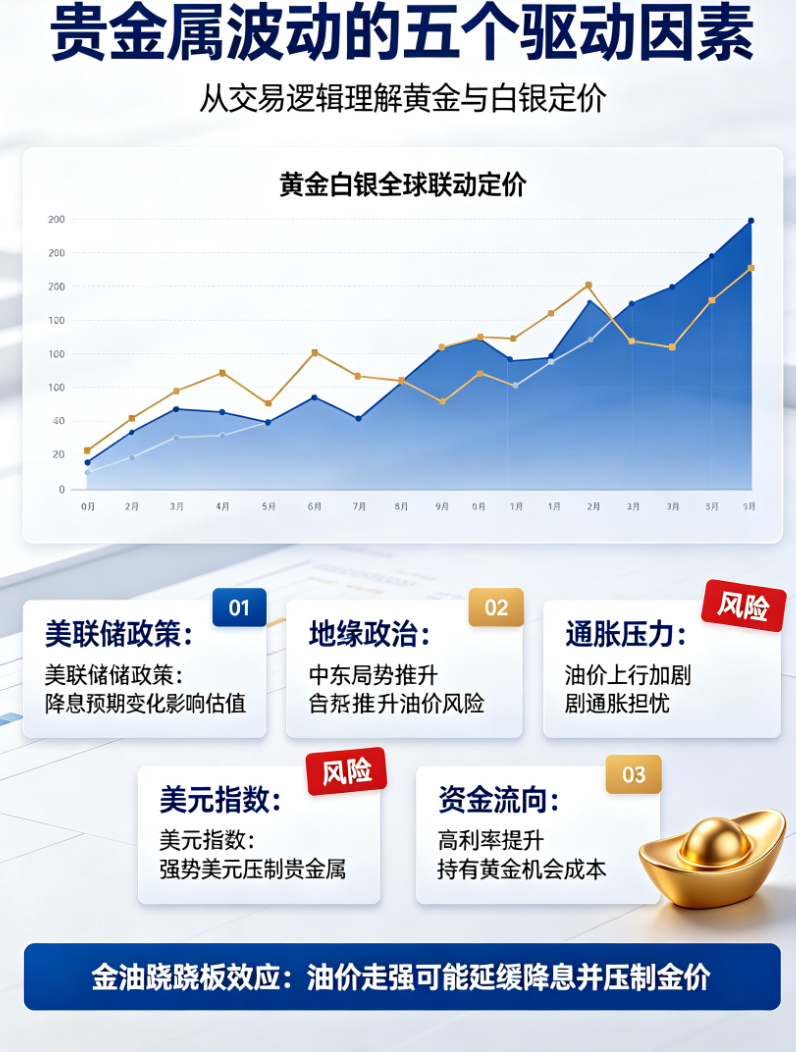
On the surface, the significant price swings in precious metals are due to the excessive cumulative gains of gold and silver in the early period, with long-position concentration rising to historical extremes. After a reversal in short-term market sentiment, overbought technical conditions led to persistent correction pressure, and profit-taking pressure was released in a concentrated manner, accelerating the price pullback. However, at a deeper level, the violent fluctuations in the precious metals market may go beyond general economic principles, concealing considerations of international politics and global strategies. The battle for precious metal resources has escalated from financial speculation to national strategic games, revolving around gold, silver, platinum group metals, and high-value industrial precious metals, characterized by highly concentrated resource distribution, profound changes in demand structure, and multi-dimensional means of contention.
Gold: The "Ultimate Currency" Beyond Sovereign Credit
Just as Marx quoted Sir Dudley North in Das Kapital: "Gold and silver, like all other commodities, have their ebb and flow." But the ultimate value of precious metals still lies in their function as a non-sovereign credit anchor, not in short-term price speculation. Currently, high US debt and expanding fiscal deficits continue to erode the foundation of dollar credit; meanwhile, global central banks are accelerating the optimization of foreign exchange reserve structures, with emerging markets becoming the main force for gold purchases. Amid the trend of de-dollarization and the restructuring of the global monetary credit system, gold, as an asset requiring "no sovereign credit endorsement," is evolving from a traditional safe-haven tool into a "super-sovereign currency anchor."
Silver: High Elasticity Investment Under Dual Attributes
Unlike gold's "super-sovereign currency anchor" role, silver has a "dual attribute" – combining financial safe-haven and industrial application properties. Silver is widely used in photovoltaics, electronics, chemicals, and other fields, meaning that silver prices are not only influenced by factors affecting gold but also closely related to the global industrial cycle, exhibiting strong cyclicality. Since 2025, the global silver market has been in a supply deficit for several consecutive years, providing fundamental support for silver DCA. Historical data shows that in precious metals bull markets, silver often outperforms gold. For example, from 2025 to early 2026, when gold rose about 70%, silver rose about 80%. This high elasticity stems from silver's smaller market size and stronger industrial demand elasticity.
Three Core Dimensions of Precious Metals Investment
The violent fluctuations in the precious metals market are not only a process of risk release but also an opportunity for a new cycle to emerge. In precious metals investment, gold, silver, and platinum group metals constitute three core dimensions. They are all scarce resources with inflation-hedging properties, but their different physical characteristics determine different investment logics. The core strategy for gold DCA is "long-term holding + asset allocation," with the key being disciplined holding and avoiding frequent trading, focusing on long-term indicators such as central bank gold purchases and the US Dollar Index. The strategy for silver DCA focuses on "cycle capture + tactical adjustments," requiring consideration of economic cycles, industrial demand, industrial policies, and special vigilance against demand shocks from economic recessions. Unlike gold and silver, platinum group metals DCA requires close attention to price-influencing factors such as automotive industry dynamics, hydrogen energy technology progress, and supply-demand conditions.
Conclusion: DCA – Life Wisdom to Navigate Cycles
From the perspective of behavioral finance, DCA is a practice that goes against human nature, requiring overcoming greed and fear – which can lead to irrational behaviors like "chasing highs and selling lows," resulting in buying at peaks or missing out. The German philosopher Schopenhauer once said: "Life is not getting what you want – it's pain; getting what you want – it's boredom. So life oscillates between pain and boredom." The core logic of DCA lies in its ability to transcend greed and fear. Rather than trying to predict market tops and bottoms, it turns investment into a disciplined habit through mechanical "regular fixed amount" operations – buying less when prices are high, buying more when prices are low, and letting time "smooth out" price fluctuations.
Looking back from the present, from $35/oz after the collapse of the Bretton Woods system in 1971 to $5,000 in 2026, gold has proven its resilience as the "ultimate currency" over 55 years. And DCA, with its simple investment logic and wisdom, navigates cycles: rather than trying to predict the future, use discipline to counter volatility; rather than pursuing short-term huge profits, use time to exchange for space, using today's certainty to counter tomorrow's uncertainty. This is not only a triumph of long-termism, but also the patience and ability to remain calm and rational in uncertainty, along with a profound awareness and reflection on human weaknesses – perhaps this is time's fairest gift to ordinary investors, and perhaps more precious than gold.
Keywords: Precious Metals Market, Price Volatility, DCA Strategy, Gold Investment, Silver Investment

ข้อควรระวังด้านลิขสิทธิ์: บทความนี้เป็นข้อมูลต้นฉบับของ ThaiDivi กรุณาติดต่อเราสำหรับการขออนุญาตเผยแพร่ซ้ำ