Colored/Precious Metals Market Deep Analysis: The Dual Game of Geopolitical Risk and Supply-Demand Structure
Introduction
In mid-July 2026, global financial markets are oscillating amidst numerous uncertainties. The ongoing escalation of the US-Iran conflict, unexpected cooling in US inflation data, and structural changes in global supply chains collectively form the complex backdrop for the colored and precious metals market. This article will provide a systematic analysis of key commodities such as precious metals, copper, nickel, lithium carbonate, alumina, and aluminum from three dimensions: macroeconomic, geopolitical, and fundamental supply-demand, to reveal the market's operating logic and future trends.
I. Precious Metals: The Tug-of-War Between Cooling Inflation Data and Geopolitical Risk
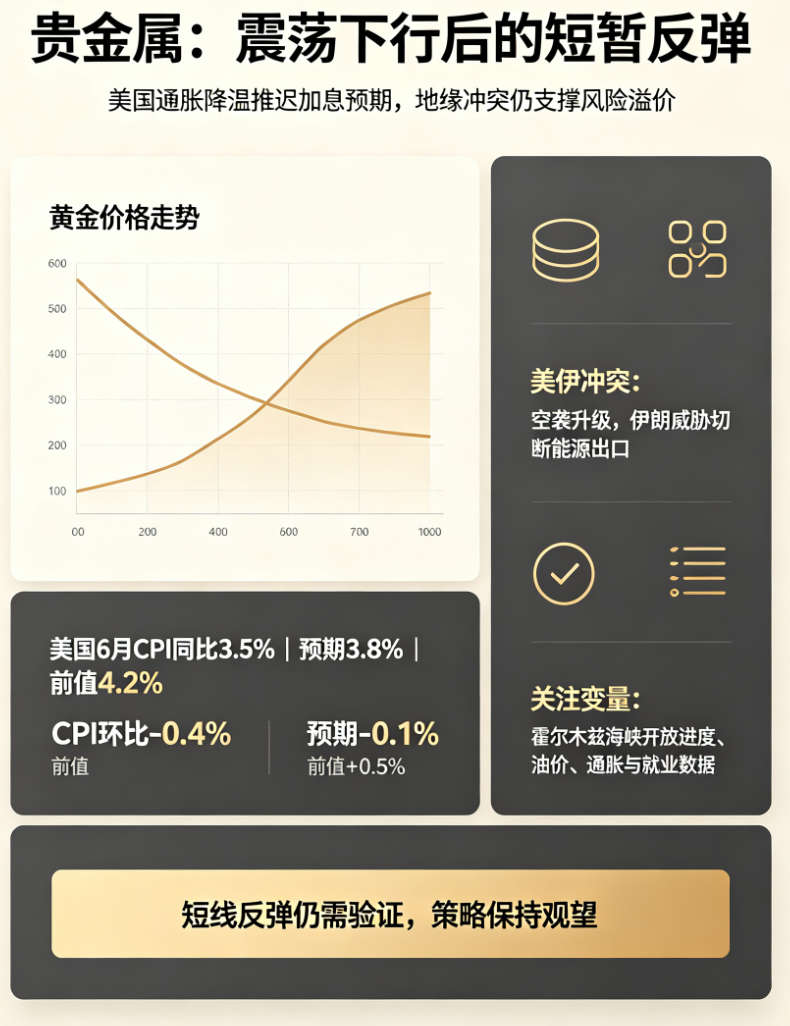
The precious metals market has recently shown volatile downward trends, but the battle of bearish sentiment remains fierce. From a macroeconomic perspective, the US June Consumer Price Index (CPI) rose 3.5% year-over-year, below market expectations of 3.8%, while core CPI remained mild. This disappointing inflation report once pushed back expectations for interest rate hikes by the Federal Reserve, weakening the dollar and providing a temporary rebound momentum for precious metals.
However, the escalation of geopolitical risk is becoming a key factor constraining the upside for precious metals. The intensification of the US-Iran conflict, with the US military launching multiple airstrikes against Iran aimed at reopening the Strait of Hormuz and weakening Iran's military capabilities, is a critical factor. Iran responds with threats to cut off more regional energy exports, bringing the bilateral game into a stage concerning national survival. This uncertainty leads to oil price increases, and concerns about future inflation persist. Fed Chair Vosch explicitly stated at a hearing that they cannot tolerate persistent high inflation and emphasized that rate hikes based on data cannot be entirely eliminated in the short term.
Overall, precious metals face a dual impact of "favorable for cooling inflation" and "favorable for geopolitical risk, but constrained by interest rate expectations." The strategy is to observe, closely tracking the actual progress of the Strait of Hormuz opening and subsequent US economic data.
II. Copper: Dual Support from Mine Shortages and Inventory Drawdown
The copper market is currently in a tug-of-war between macroeconomic pressure and resilient fundamentals. From a macroeconomic standpoint, cooling inflation data in the US in June has eased expectations for year-end rate hikes, but geopolitical uncertainty remains high. On the fundamentals, the cost of copper ore processing (TC) remains at a deep low, and the pattern of strong mines versus weak smelting persists, reflecting tight supply conditions at the mine end.
It is noteworthy that there has been a significant seasonal drawdown in domestic social inventories. As of July 16th, domestic copper cathodes inventory decreased to 131,400 tons, a decrease of 38,500 tons from the previous week. This phenomenon is due to several factors: a shortage of domestic ore shipments recently, downstream companies building up inventory due to typhoon impacts, and rising spot prices from delivery exchanges. However, the price increase for copper clearly suppressed downstream purchasing intent, and spot transaction volumes declined, indicating limited demand resilience.
From a medium to long-term perspective, the core logic of insufficient supply at the mine end remains valid, providing strong downside support for copper prices. In the short term, copper prices may continue to fluctuate, and investors should monitor changes in macroeconomic sentiment and the persistence of inventory drawdown.
III. Nickel and Stainless Steel: Weakness Amidst Expected Supply Relaxation
Since May, nickel prices have continued to decline, breaking below the 140,000 mark, with capital continuing to flow out, resulting in a weak overall trend. The core change in the nickel market is in supply expectations: Indonesia may increase RKAB nickel mineral allocation in July, which will weaken the previous market logic of tight nickel mineral trading. Meanwhile, the export situation for Middle East sulfur and sulfurs has improved, and market expectations for shortages are beginning to loosen.
Regarding downstream demand, nickel inventories continue to set new highs, and stainless steel inventories are at seasonal highs with orders continuously increasing. In the absence of new upward drivers, nickel prices are expected to maintain a weak oscillating pattern. However, cost support still exists on the downstream side: sulfur prices remain high before the Strait of Hormuz fully opens; nickel mineral prices are also high, and there is uncertainty regarding mineral allocations, which will limit the downward space for nickel prices.
IV. Lithium Carbonate: Supply and Demand Pattern Improves, Fundamental Support is Clear
The lithium carbonate market has recently shown stronger fundamental support. According to SMM data, the increase in inventory primarily comes from refurbished old stock, recycled material, and some regions' spodumene, which differ in quality consistency compared to new material, so the actual sellable quantity remains tight. Supply-side disruptions continue, while demand shows strength: production levels remained high in June, and sales of energy storage batteries increased by over 100% from January to April, exceeding market expectations.
Although the anticipated rise in interest rates in the US creates some pressure on precious metals, the fundamental logic for lithium carbonate is clearer, possessing stronger downside support after price declines. Short-term strategy suggests waiting and observing, waiting for market stabilization before re-entering, with the main risk points being the deterioration of the macroeconomic environment and weakening energy storage demand.
V. Aluminum Oxide and Aluminum: Conflict Between Supply Glut and Inventory Depletion
The aluminum oxide market faces pressure from supply glut. Domestic mineral supply remains tight, but falling aluminum oxide prices lead to a decrease in corporate acceptance of high-priced minerals. Regarding imported minerals, the escalation of US-Iran relations increases shipping costs, and the monsoon season in Guinea affects transport, leading to a decrease in aluminum ore exports. On the supply side, companies undergoing pre-inspection are continuing production, and the industry operating rate remains stable, but the pressure from supply glut is still significant, and aluminum oxide prices are unlikely to rebound significantly.
The aluminum market shows a different pattern. Macroeconomic pressure still exists, but domestic social inventories are being significantly depleted, having dropped to 1,024,000 tons as of July 16, a decrease of 54,000 tons from the previous week. This large-scale inventory depletion provides support for aluminum prices, but demand faces pressure from deepening traditional off-season, declining aluminum material orders, etc. New capacity and recovered production overseas continue to release supply, also putting pressure on prices. Overall, aluminum prices are oscillating, requiring attention to changes in geopolitical situations and the sustainability of inventory depletion.
Conclusion
Overall, the precious metals market currently exhibits characteristics of "macro suppression" and "fundamental divergence." Precious metals are constrained by interest rate expectations and geopolitical risks. Copper, nickel, and other commodities seek balance between supply logic at the mine and inventory changes. Lithium carbonate shows stronger resilience due to a robust supply and demand pattern. Against the backdrop of unclear geopolitical conflicts and uncertain monetary policy paths in major economies, investors need to remain cautious, closely track the rhythm of fundamental changes, and await clearer trading signals.
ข้อควรระวังด้านลิขสิทธิ์: บทความนี้เป็นข้อมูลต้นฉบับของ ThaiDivi กรุณาติดต่อเราสำหรับการขออนุญาตเผยแพร่ซ้ำ